Driving On Irish Roads

To fully appreciate the following description of the roads in Ireland, please first find Robin Williams monologue of golf on You Tube. My post will then make more sense. I’ve tempered the language to appeal to all audiences. You make the appropriate substitution.

This is a conversation between two Irishmen in advance of creating the road system. One is asking the questions, the other is responding.

So you know that people will want to move about the country to see family, shop and get to their fields.

Oh aye. Let’s build some roads to help them.

So the road will be sufficiently wide to let two cars pass comfortably in opposite directions.

Ack noooooo. Why make it so simple.

So what about having a shoulder to the road?

Ack noooo. That’s just a waste of pavement.

Well at least we can add space at the edge of people’s property.

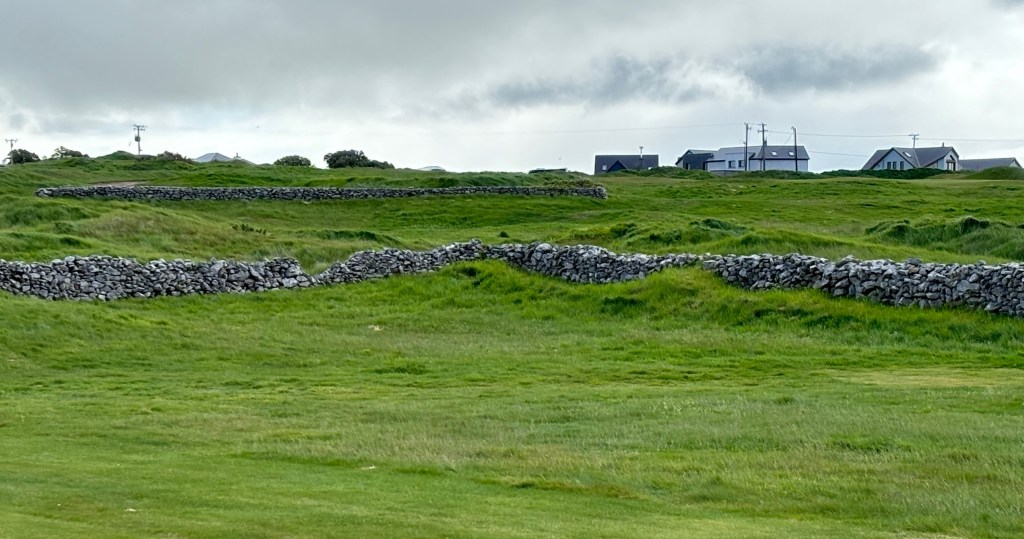
Ack nooooo. People need to build stone walls right up to the edge of the road to have the biggest lawn possible.

Well what about telephone poles? They should be set back from the road.

Ack nooooo. Let’s put them on the edge of the road just because.

OK but then we should trim the hedges so one can see all the road.

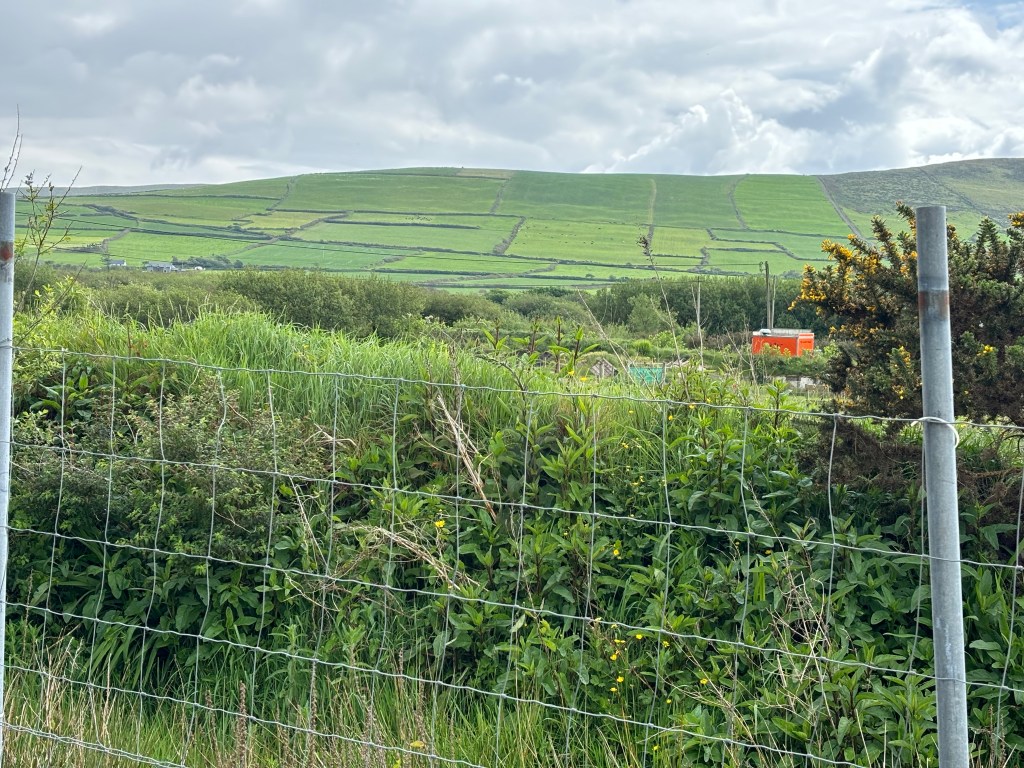
Ack noooo. Let the hedges grow as close as possible so they can appreciate Irish greenery as it slaps the outside mirrors.

Alright but what about lines on the road to show the edge and middle of the road?

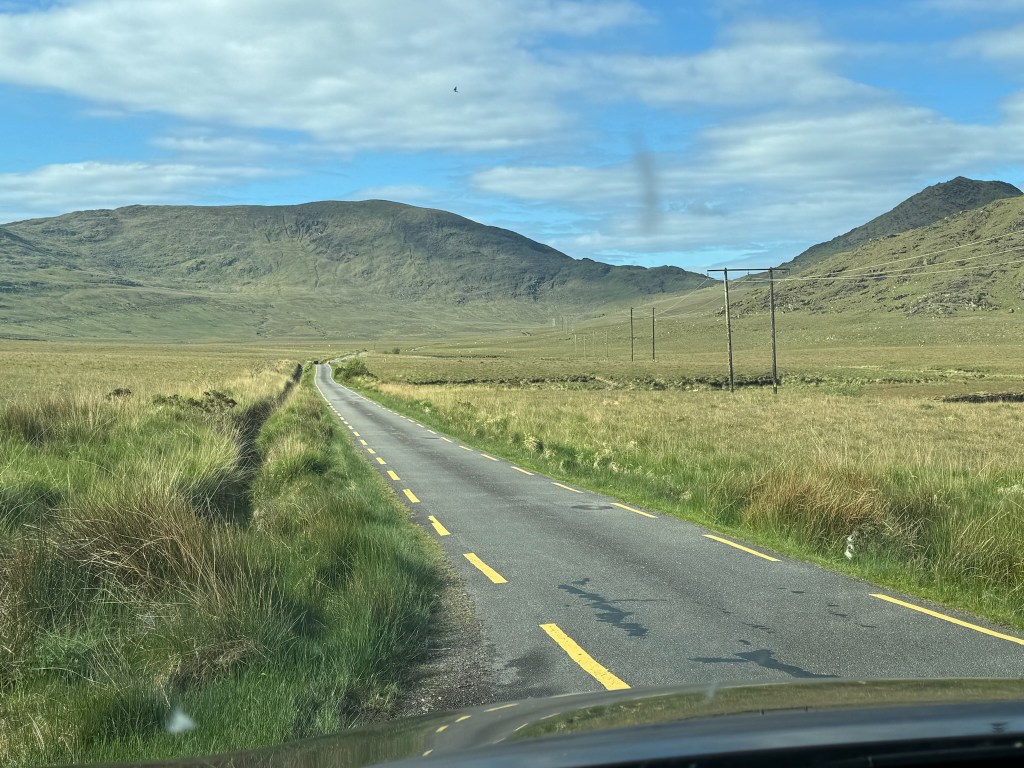
Ack noooo. That’s just a waste of paint. Let them decide what’s their side.

Given all the rolling countryside it will be easy to build roads in a straight line.

Ack noooo. We’ll put in dozens of tight, blind turns just to see what the driver is made of.

We will have to build separate roads for the farm tractors to move from field to field.

Ack noooo. Let the big buggers go where they want and at whatever speed they want.

So given all of these building ideas of course we’ll have a low speed limit to make it safe.

Ack noooo. The greater the speed the more fun. In fact, let’s give a country lane a speed limit of 100 KPH just to bring it all together.

One final question. Since most of the world has left hand drive we should follow suit.

Ack noooo. Let the foreigners figure it out as they go so we can send them home shaking their heads.

Having “survived” nearly a month driving a rental car on the “wrong” side, going down country lanes with ridiculously limited pavement, having zero visibility past hedges and sharp curves and facing oncoming cars doing the insane posted speed limit, we look forward to heading home in one piece. Ironically the Irish rental car system charges a daily insurance fee even if you decline any coverage. I guess their experience knows better. Safe travels to anyone who takes on the Irish road system. Cheers.

The European Club

Our penultimate day in Ireland meant M&M went off to play one final round of golf while P&G extended their Pit Day in Kilkenny. We planned to reunite in Dublin at days end for dinner.

The European Club is the brainchild of Pat Ruddy, one of Ireland’s most prolific course designers. He began as a golf writer then morphed to publishing a golf magazine before taking on golf architecture. His dream was to build his own links course which he finally achieved in 1992 having discovered the perfect landscape in Brittas Bay south of Dublin in the early 80’s.

A version of an Irish Standing Stone complete with a golf ball

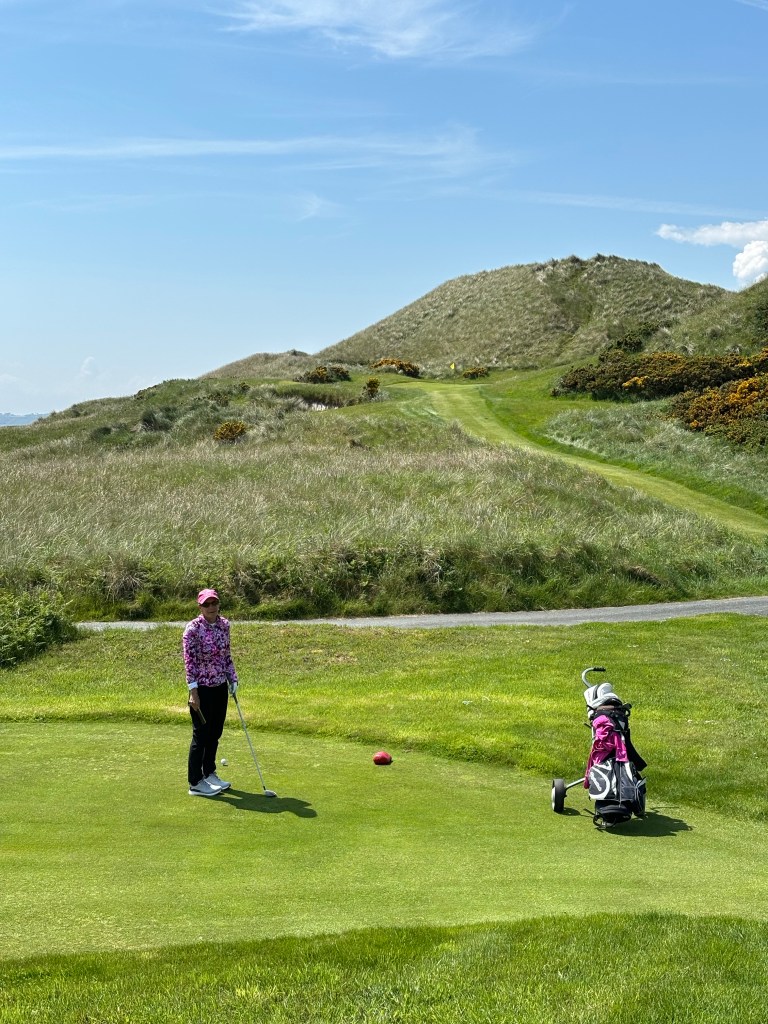
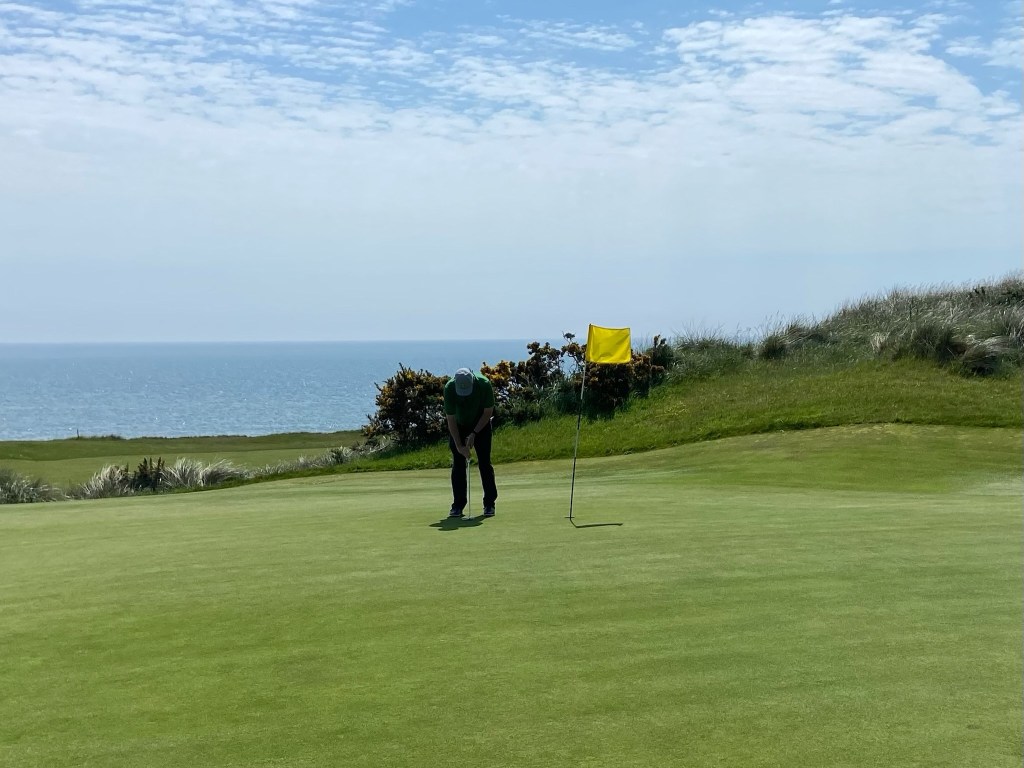
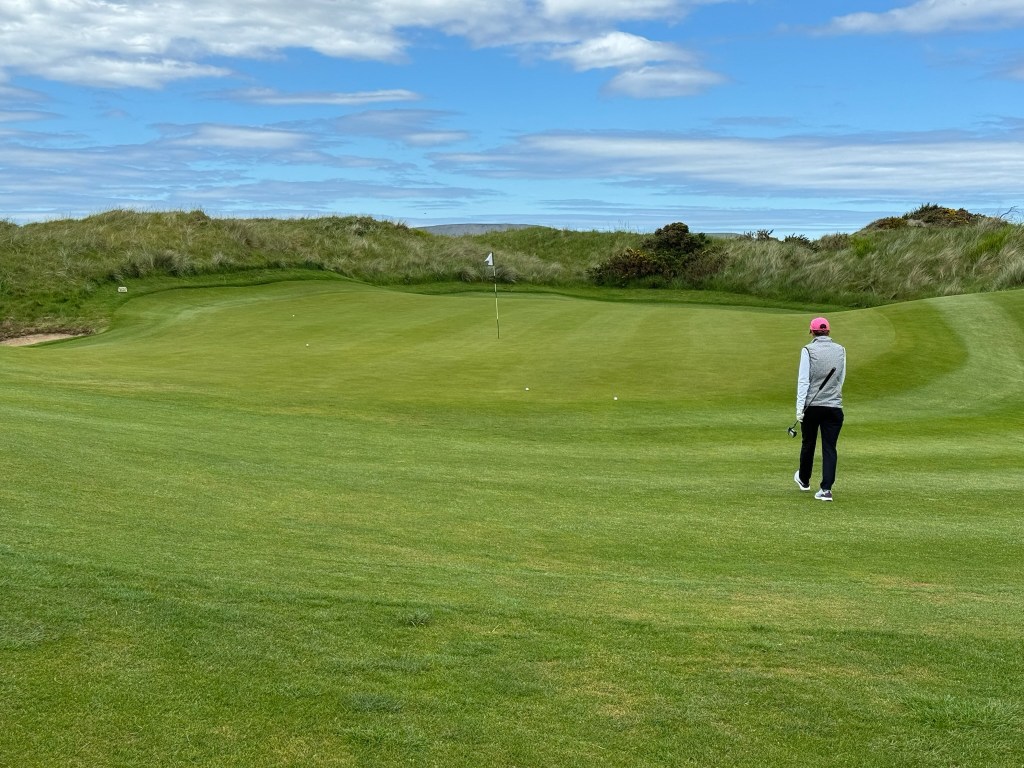
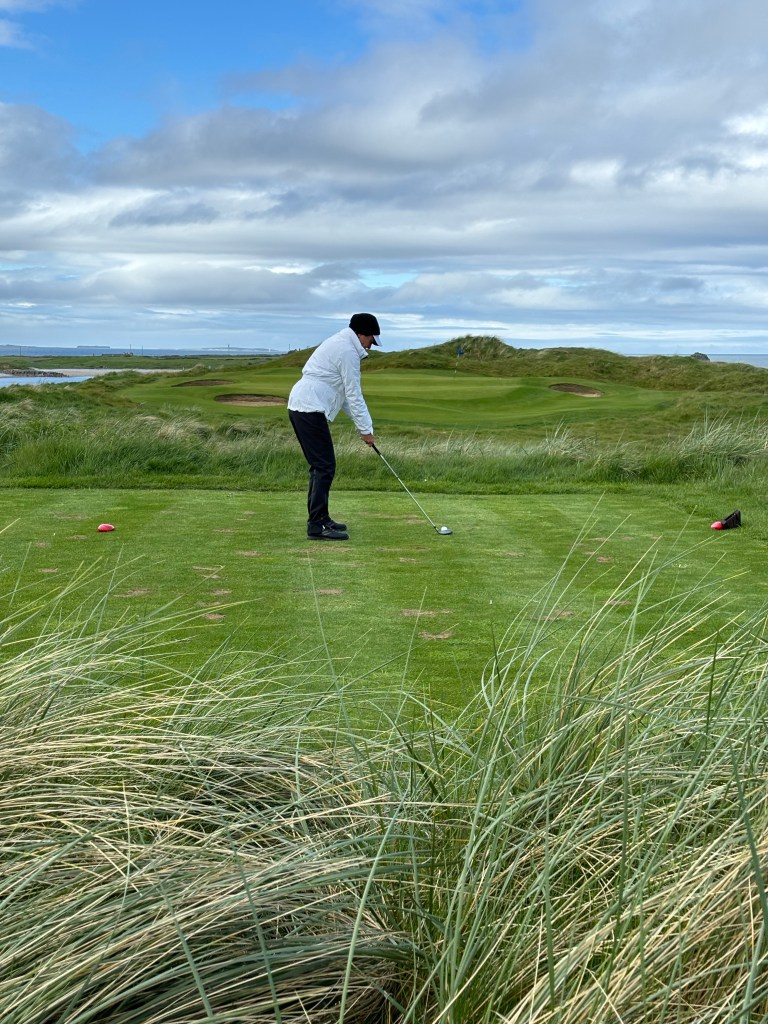
We had the pleasure of meeting Mr. Ruddy on the first tee and enjoyed ten minutes of his story telling and humorous antidotes. His pride in what he created and spent the past 30 years tweaking to improve was very evident. Then it was into the teeth of what transpired to be the most challenging and strategic course I’ve faced, maybe ever.

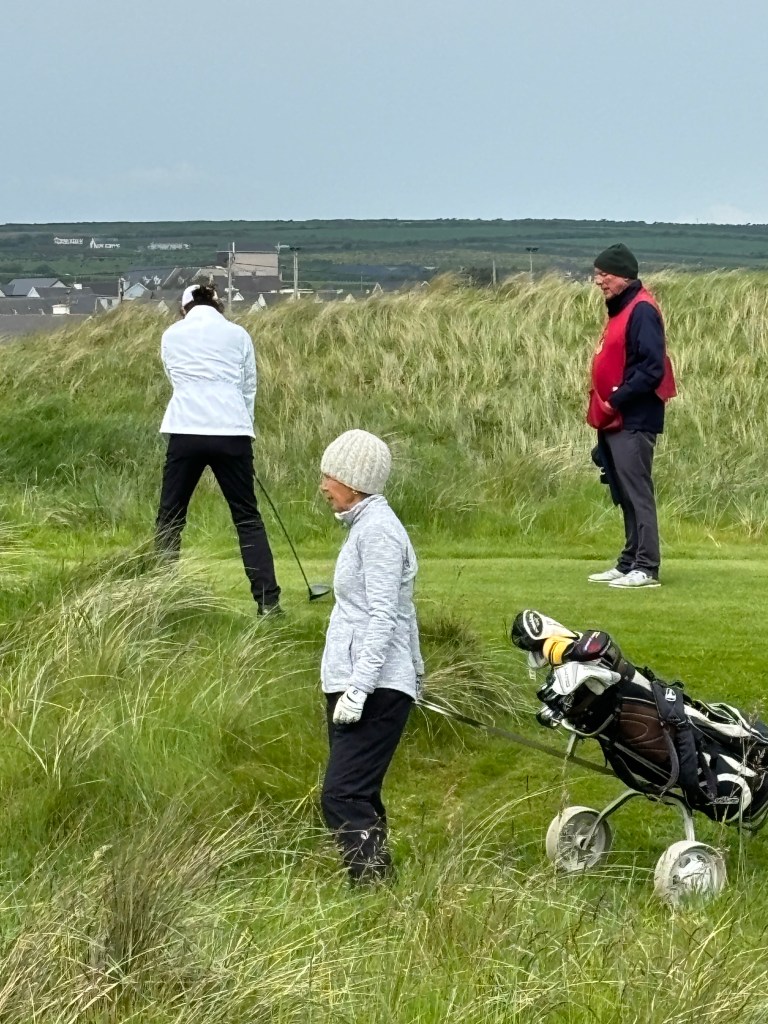
The club does not have nor permit caddies so if you wish to walk, versus take a cart, it’s carry or pull. We chose the latter given it was not just sunny but hot (22C/72F). Our fabulous weather record continues.

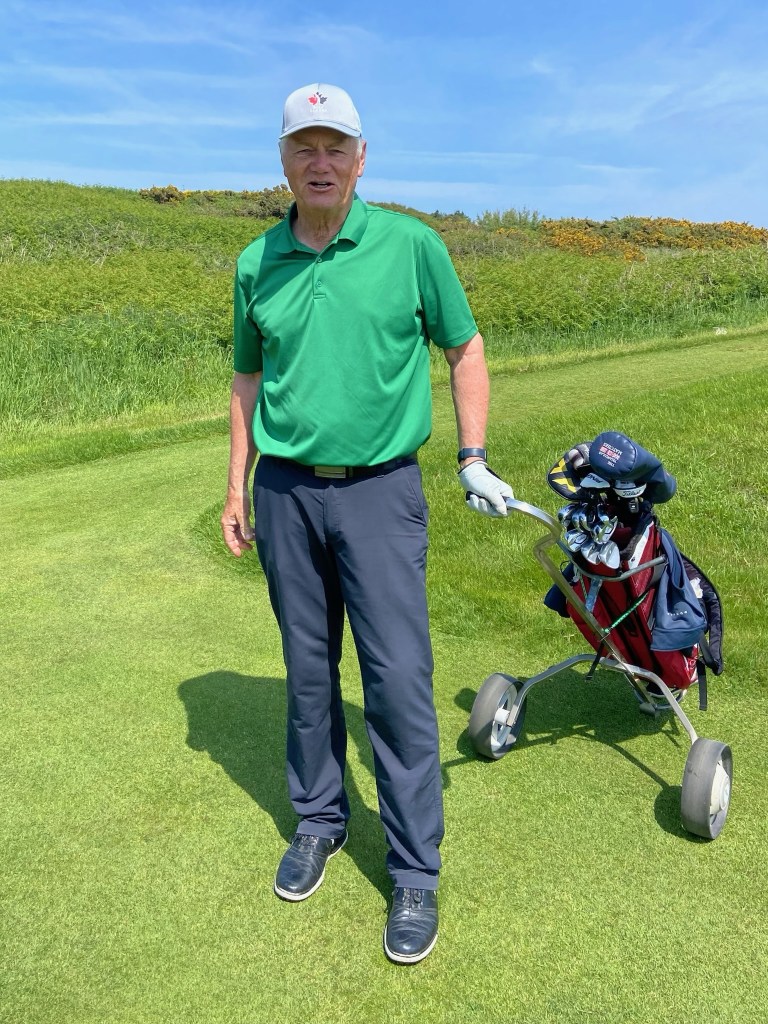
Last round meant wearing the Irish Green

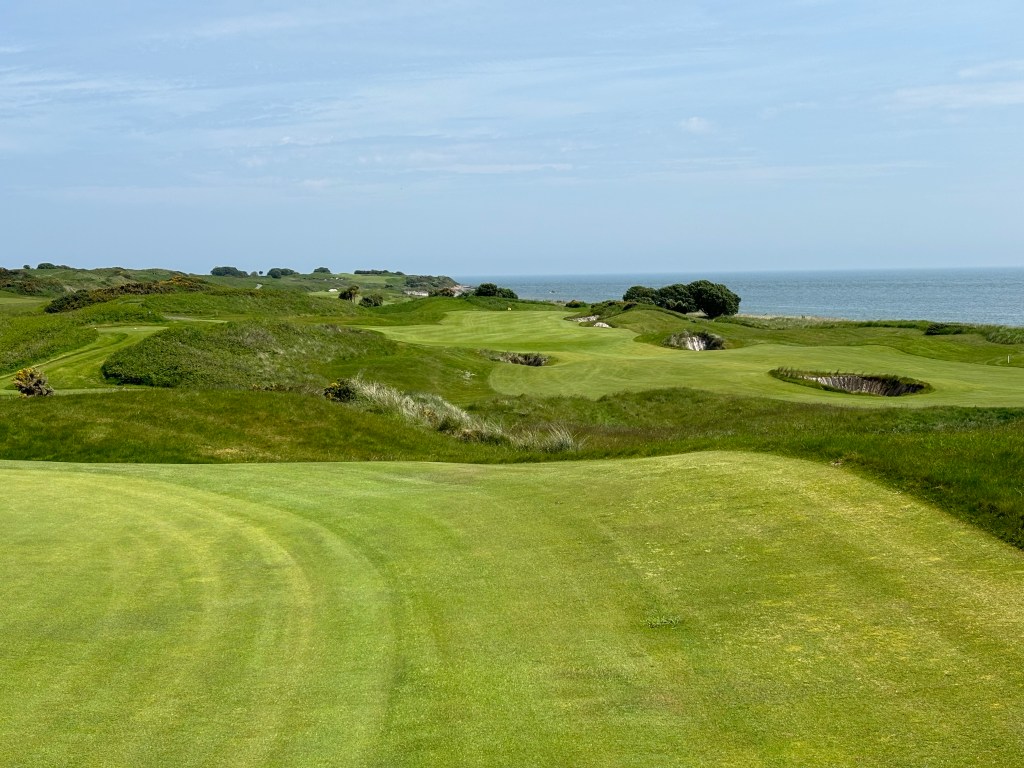
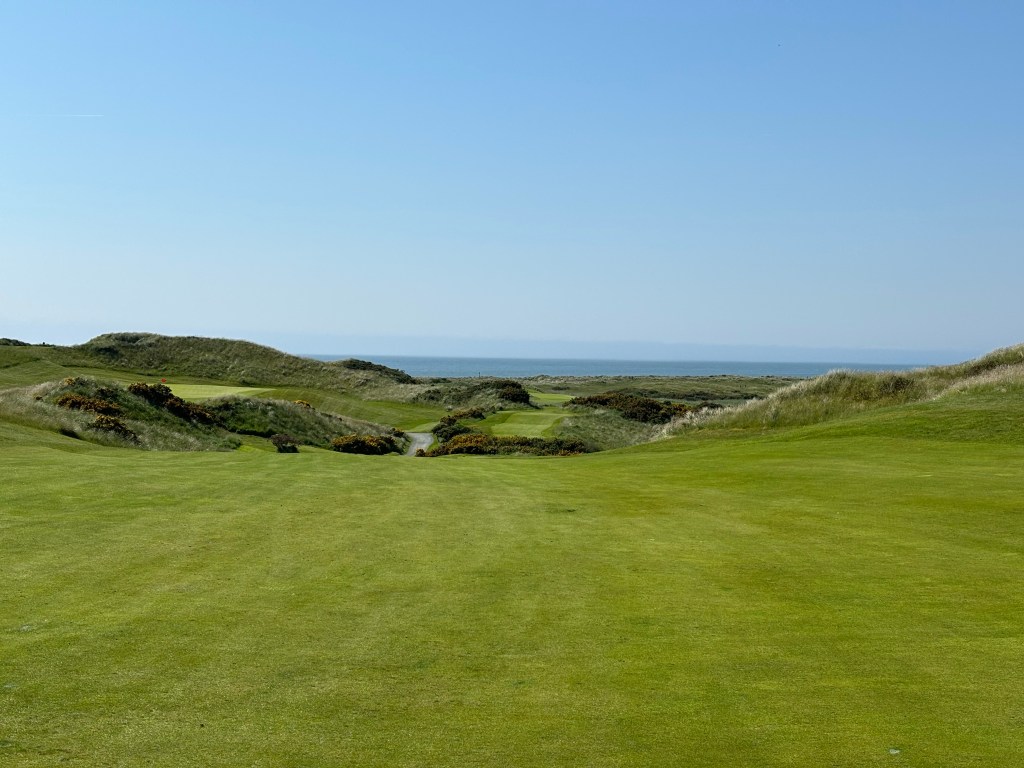
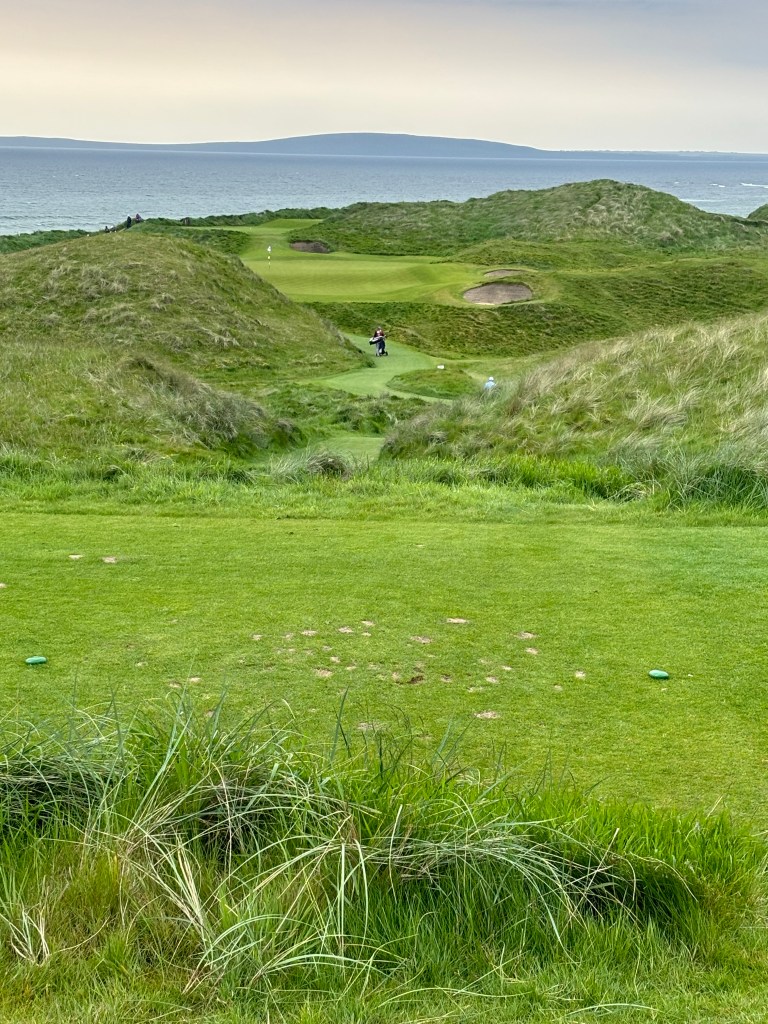
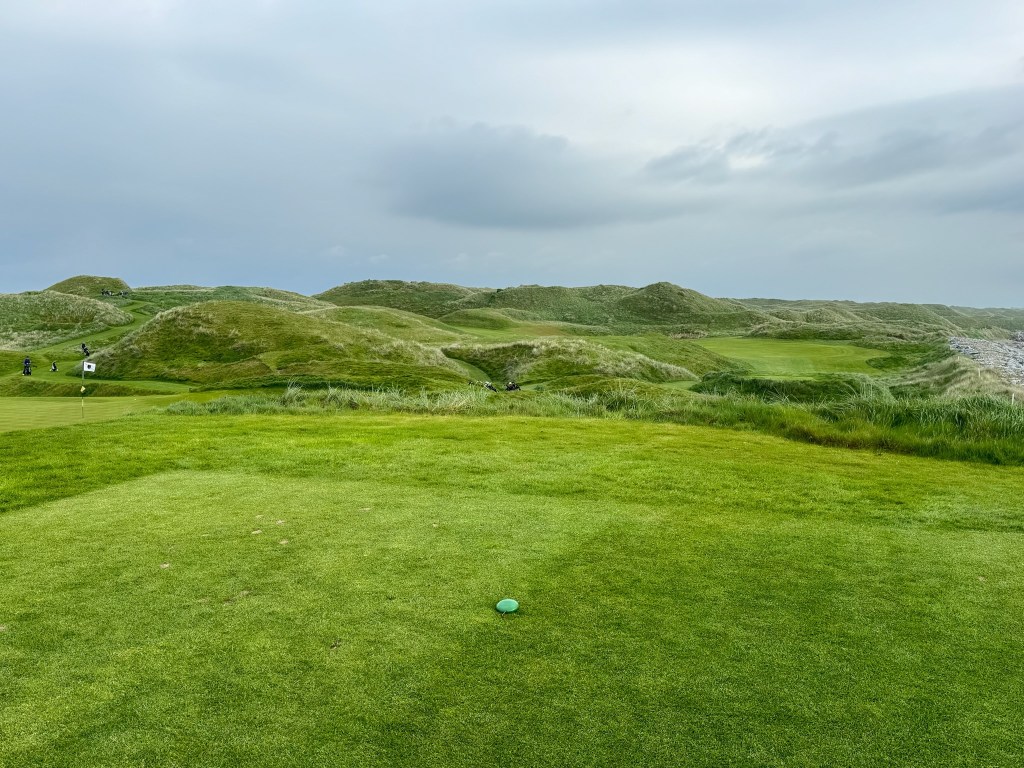
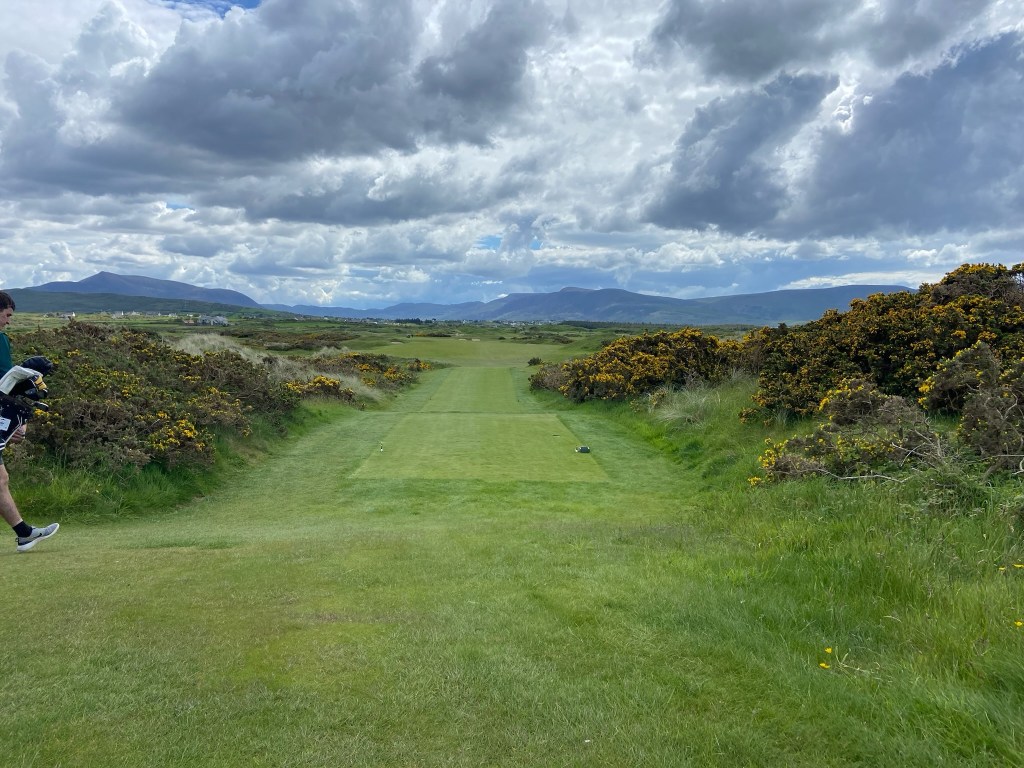
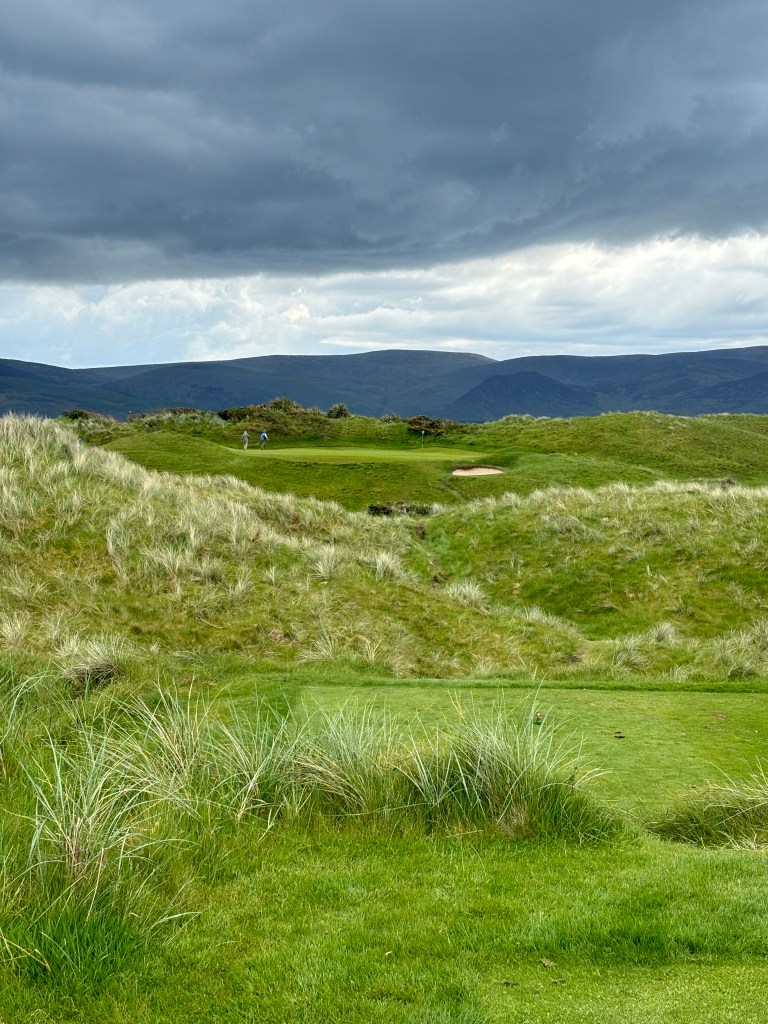
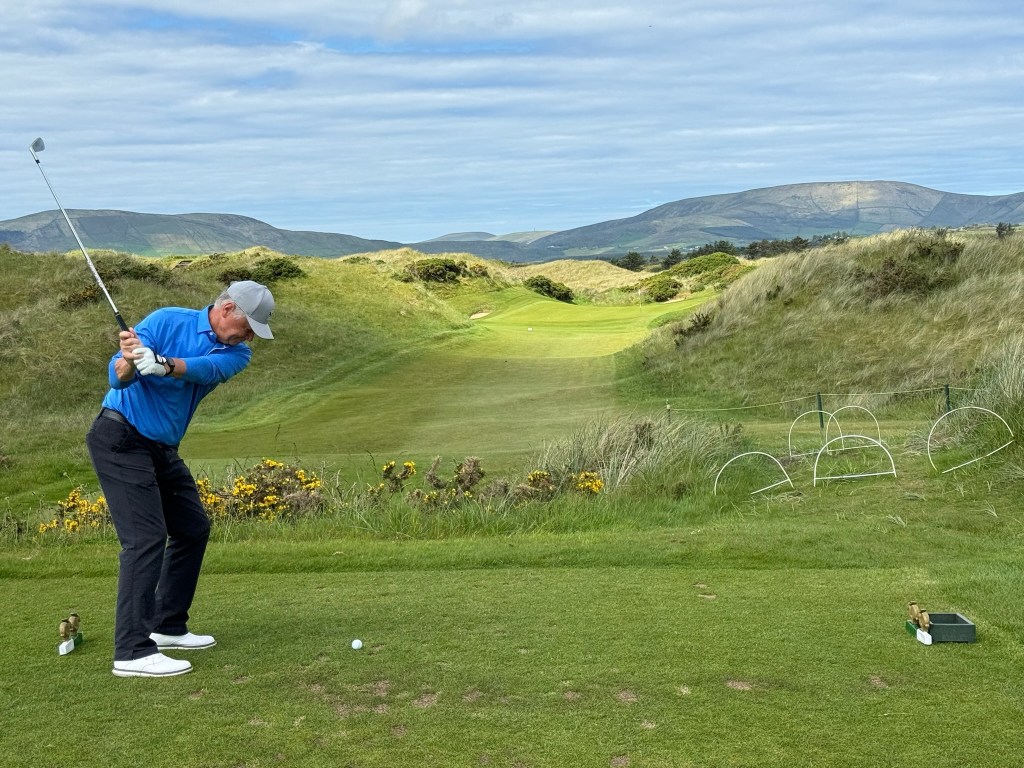
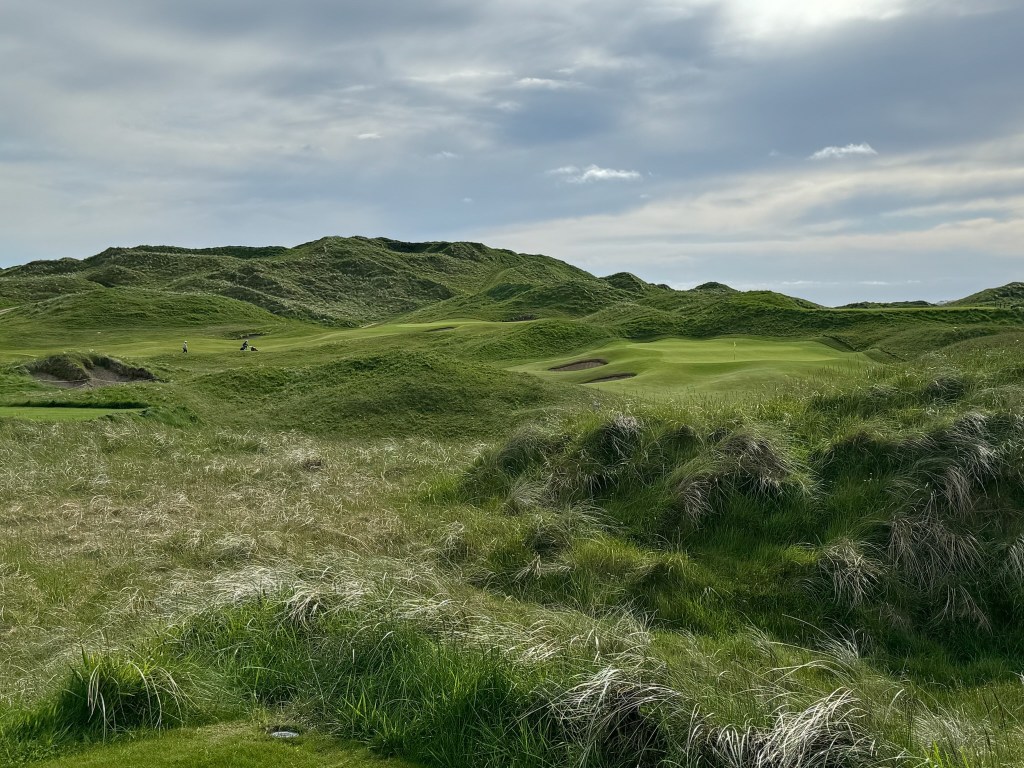
Ruddy’s design philosophy is to make you think on the tee because the view presents a dilemma of what shot length, direction and shape to play. In his words, “much is calculated deception inducing white knuckles on the club.” Objective achieved!

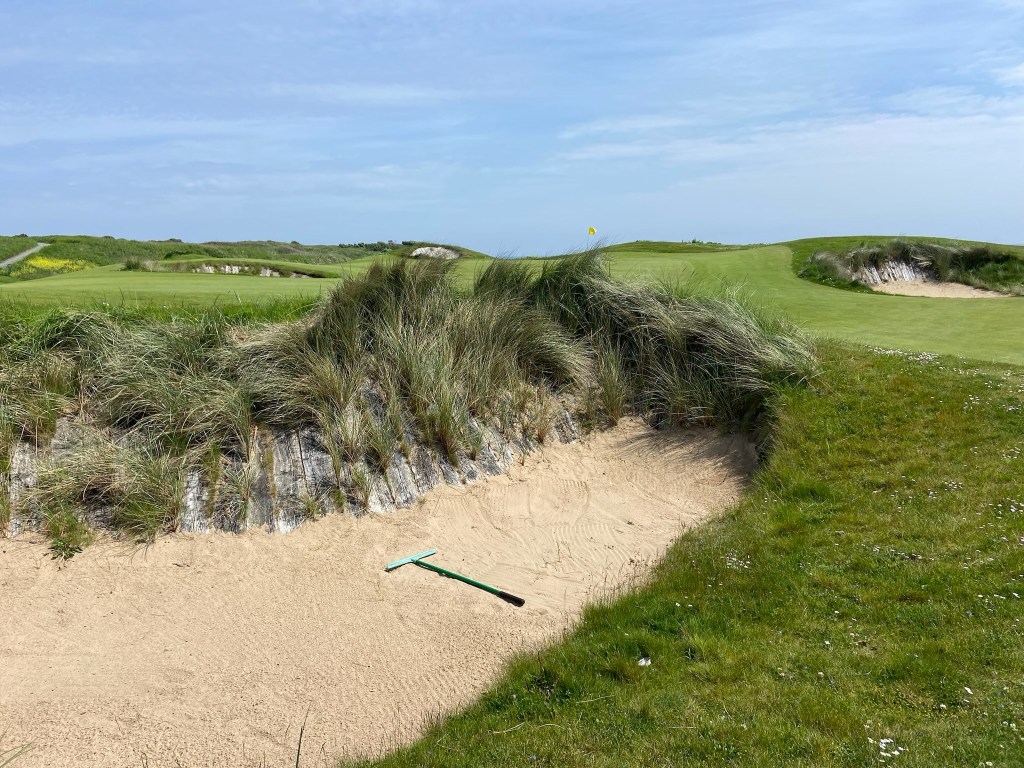
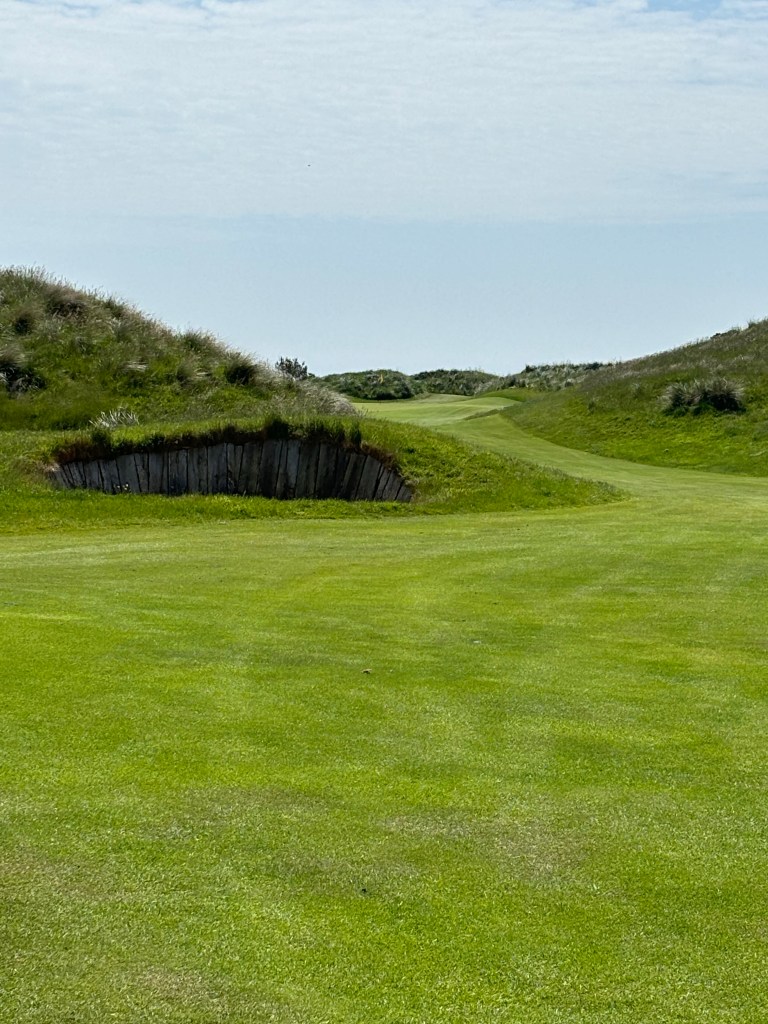
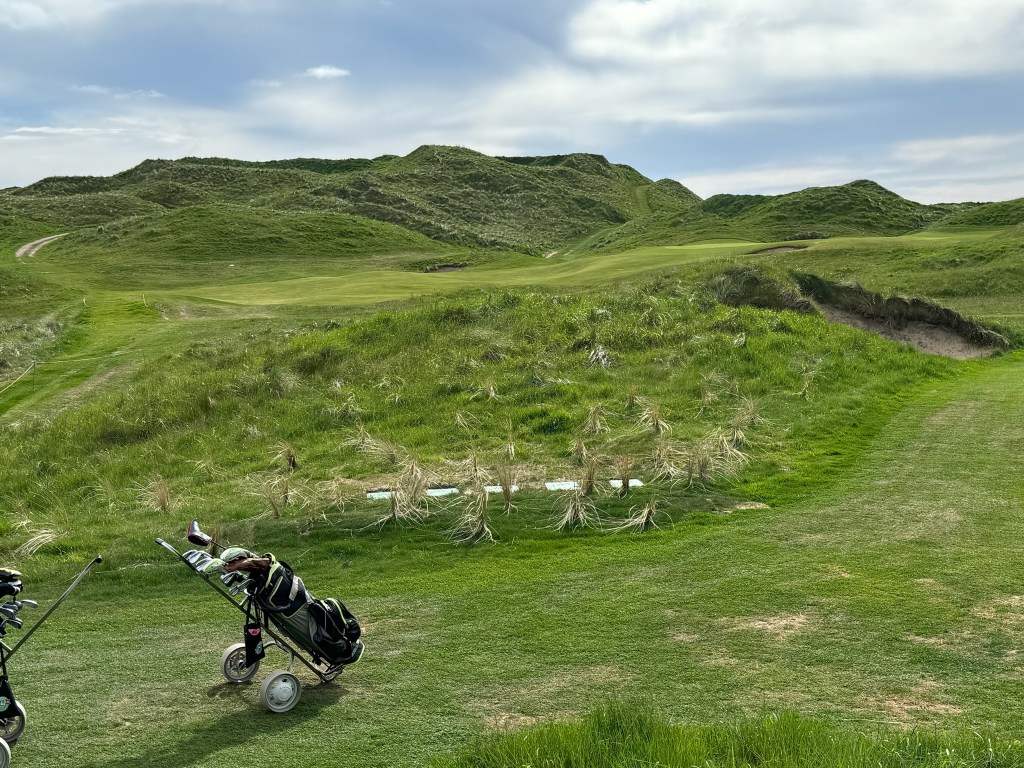
A unique feature are the incredible bunkers. Extra deep to stop the sand blowing away, faced with vertical wooden bulkheads, topped by 2 – 3 foot eyebrows where you could lose a ball.

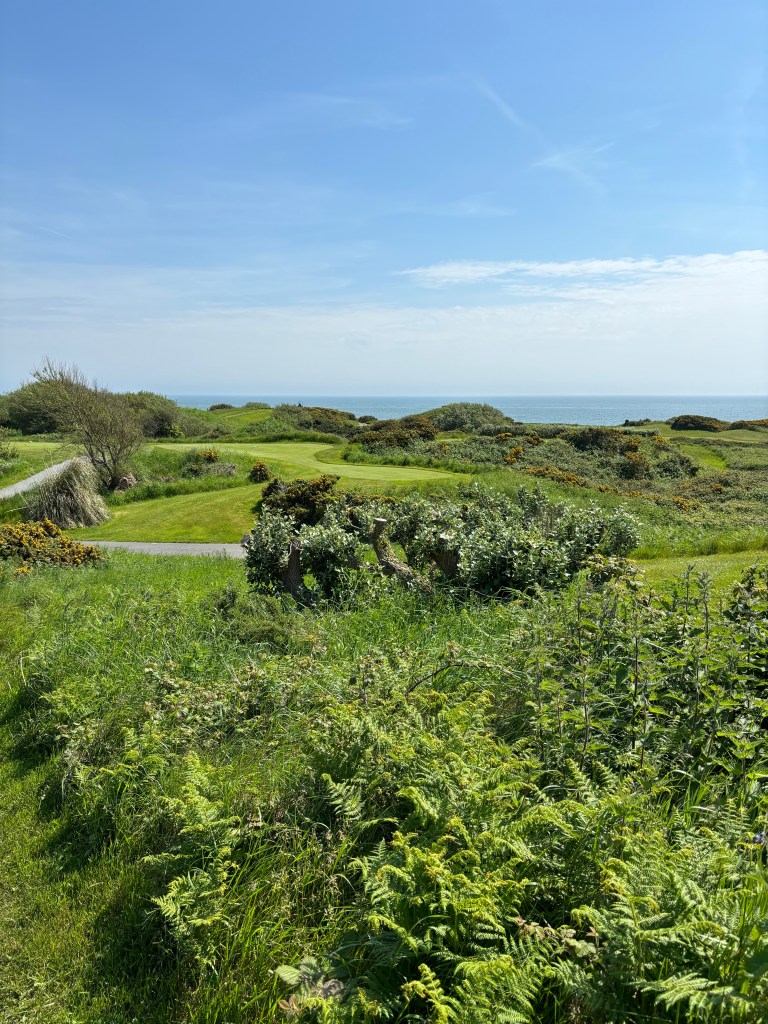
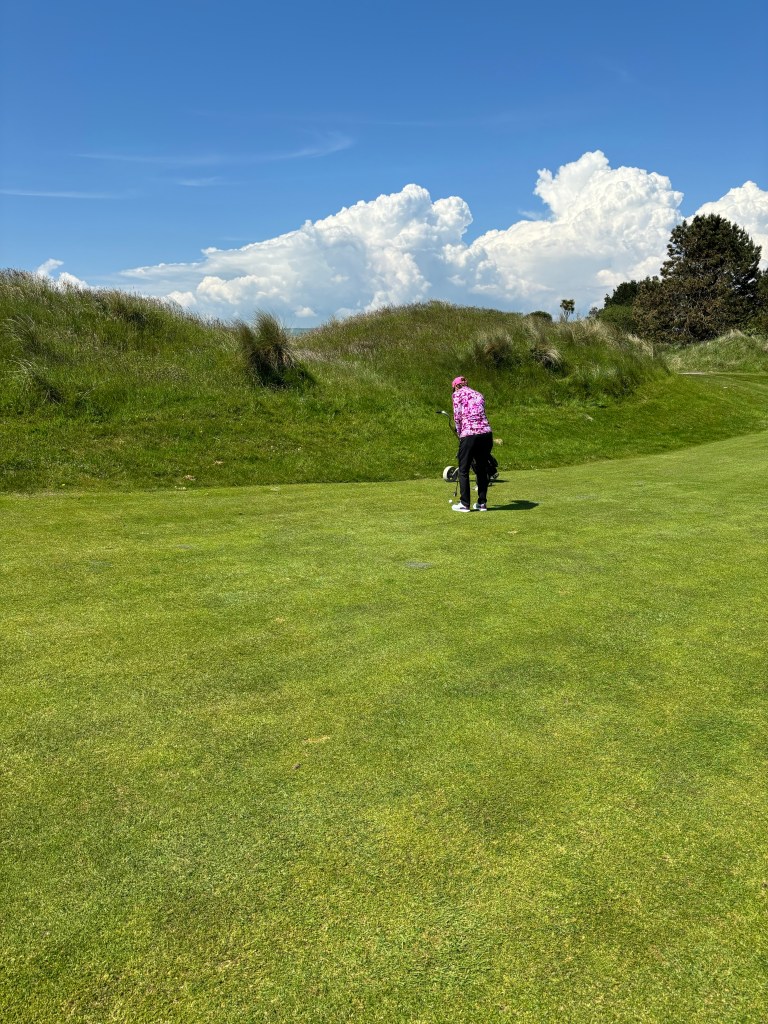
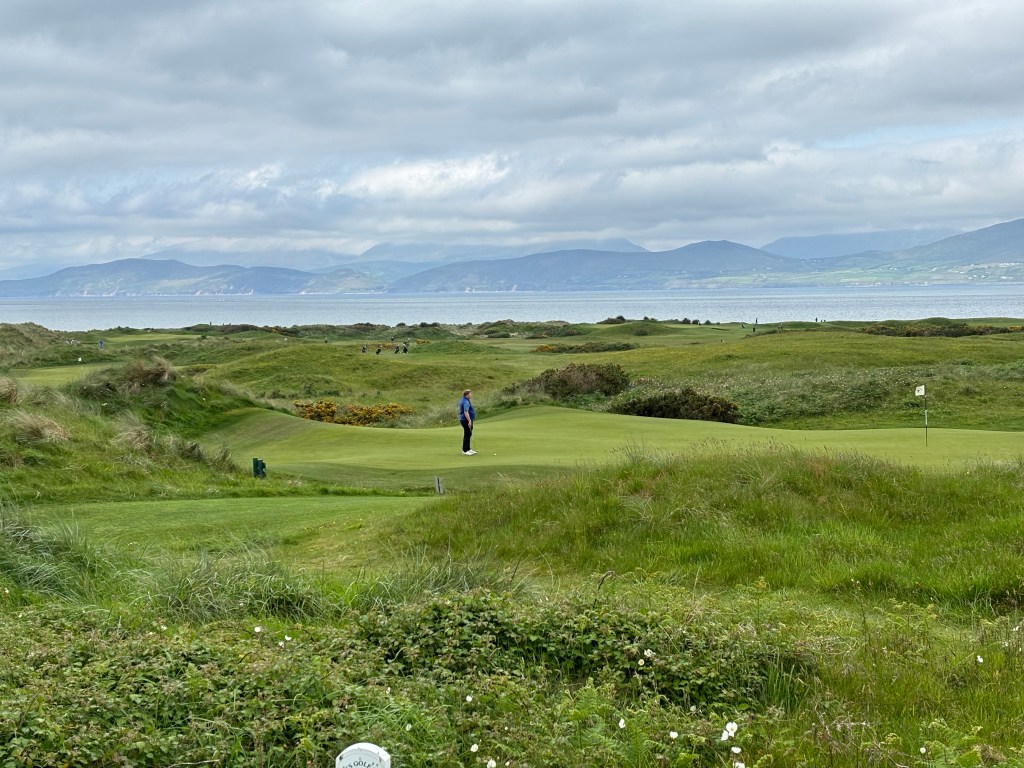
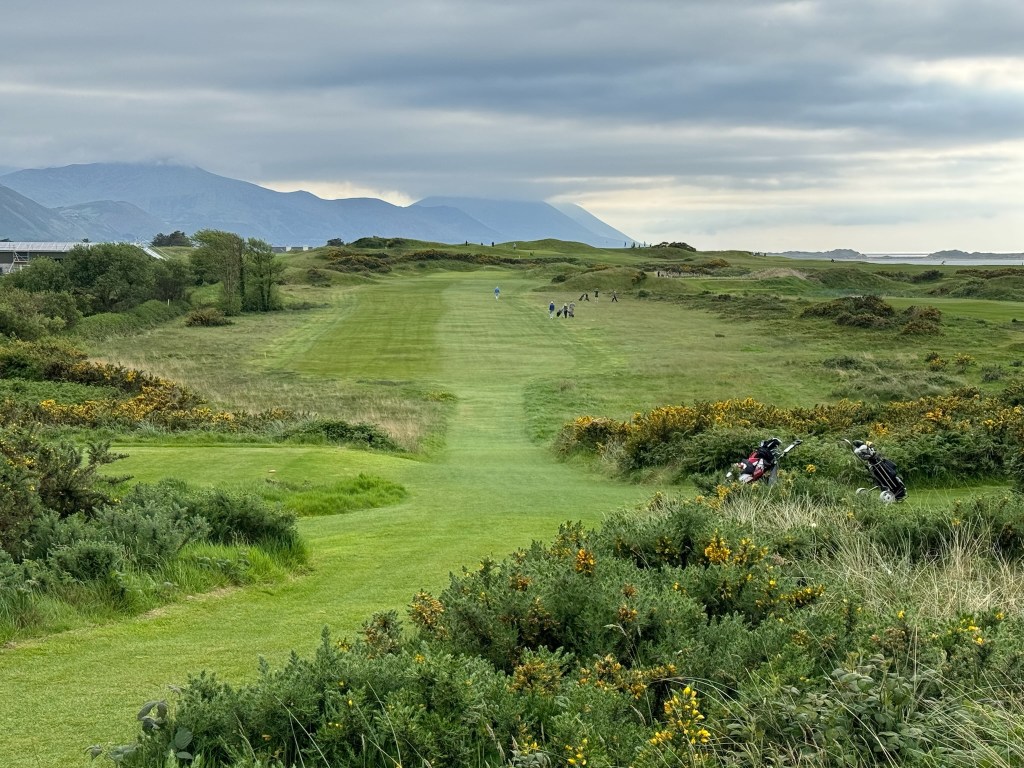
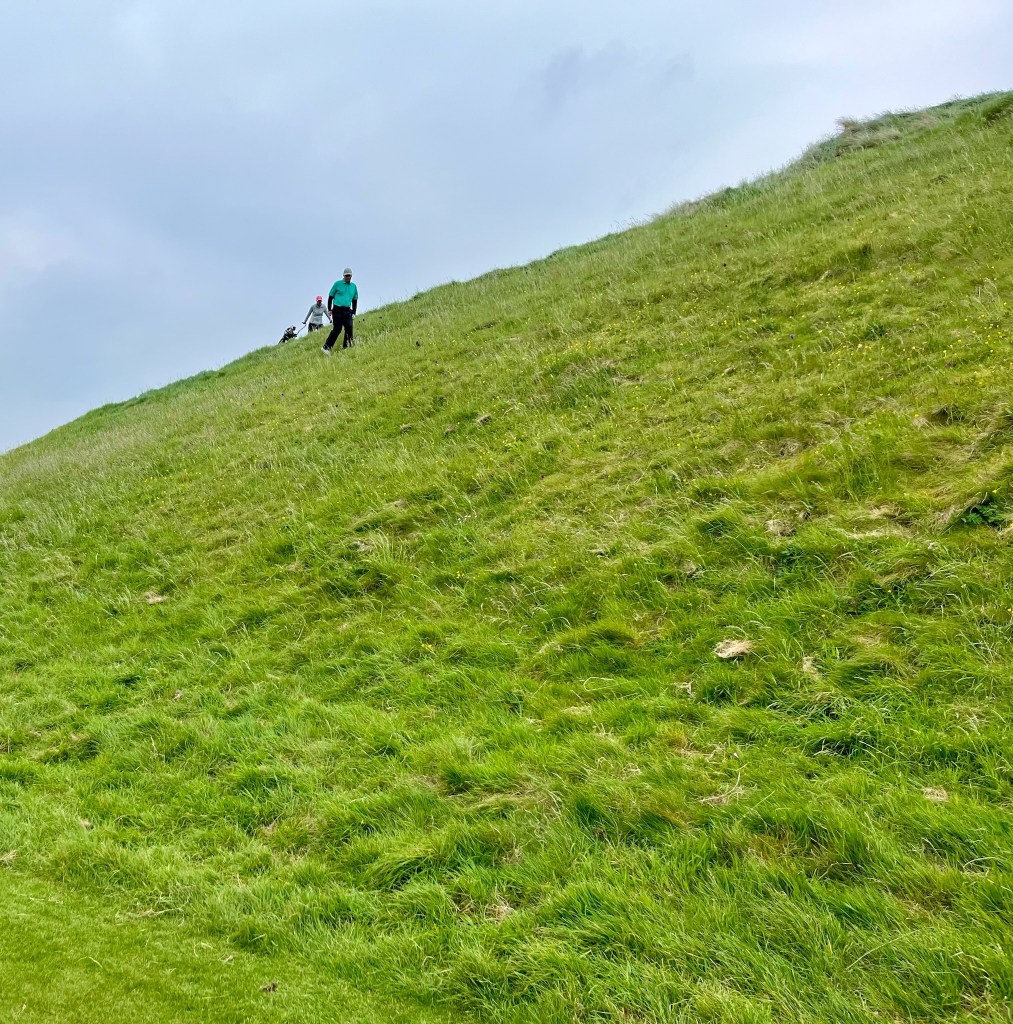
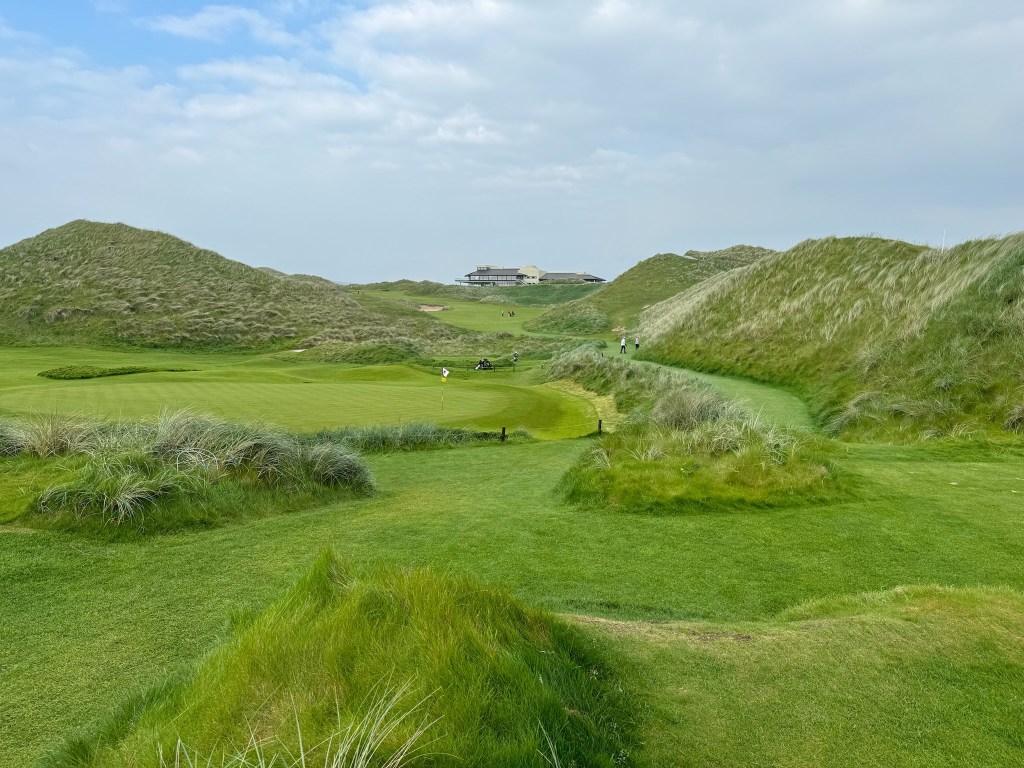
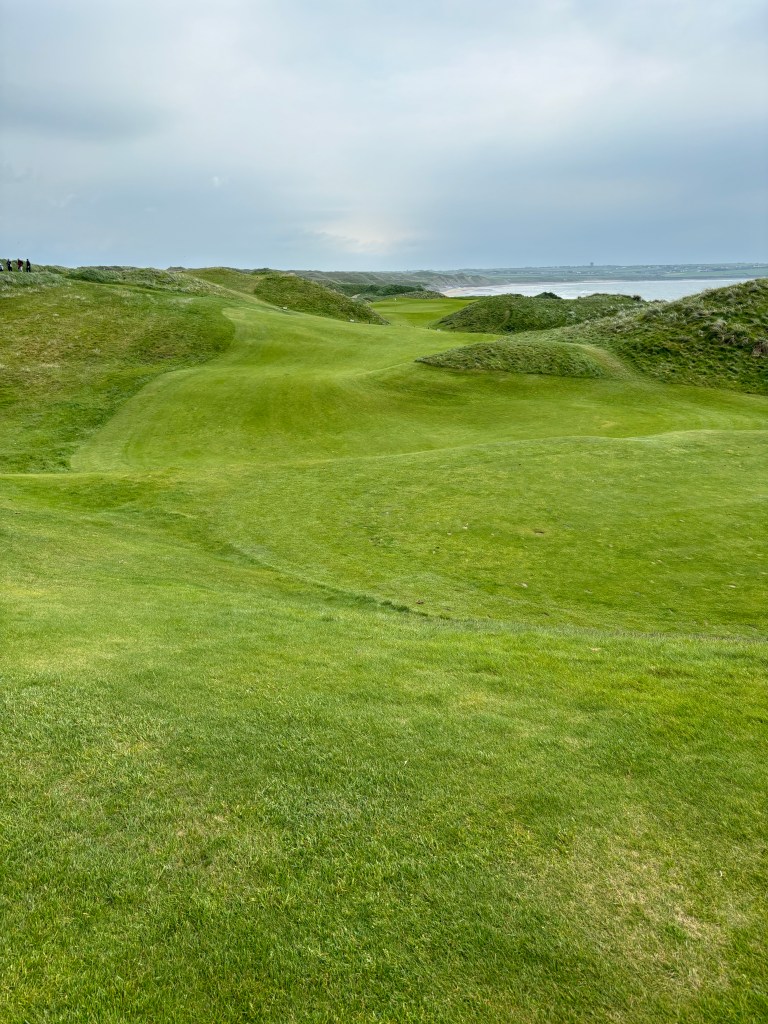
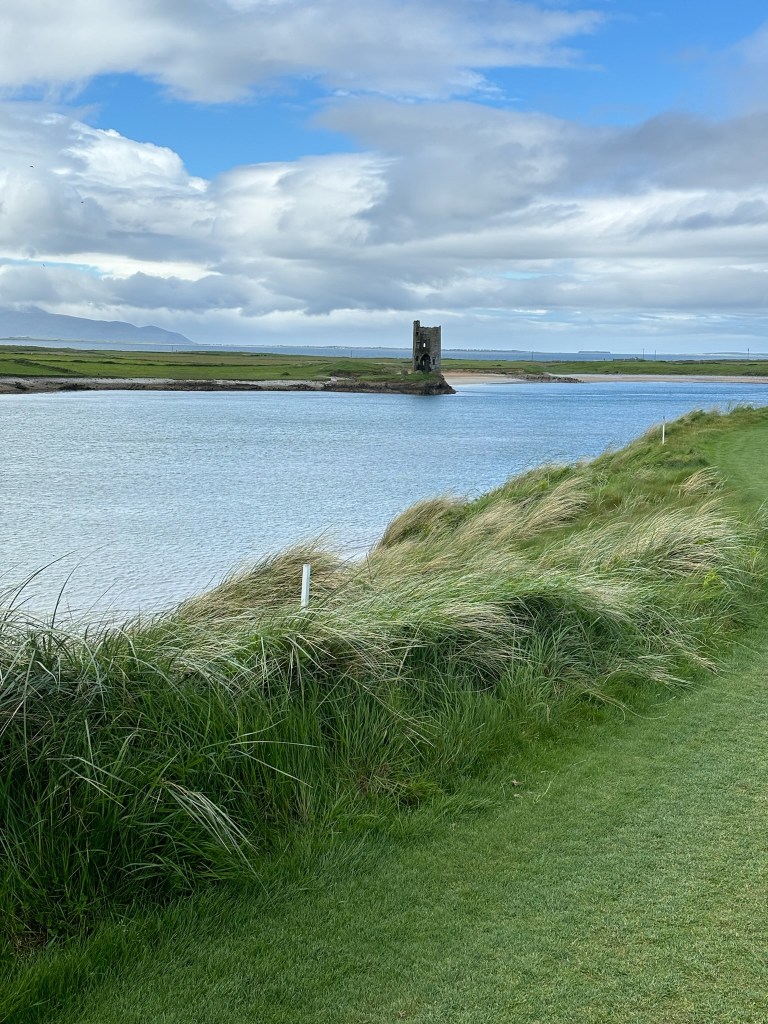
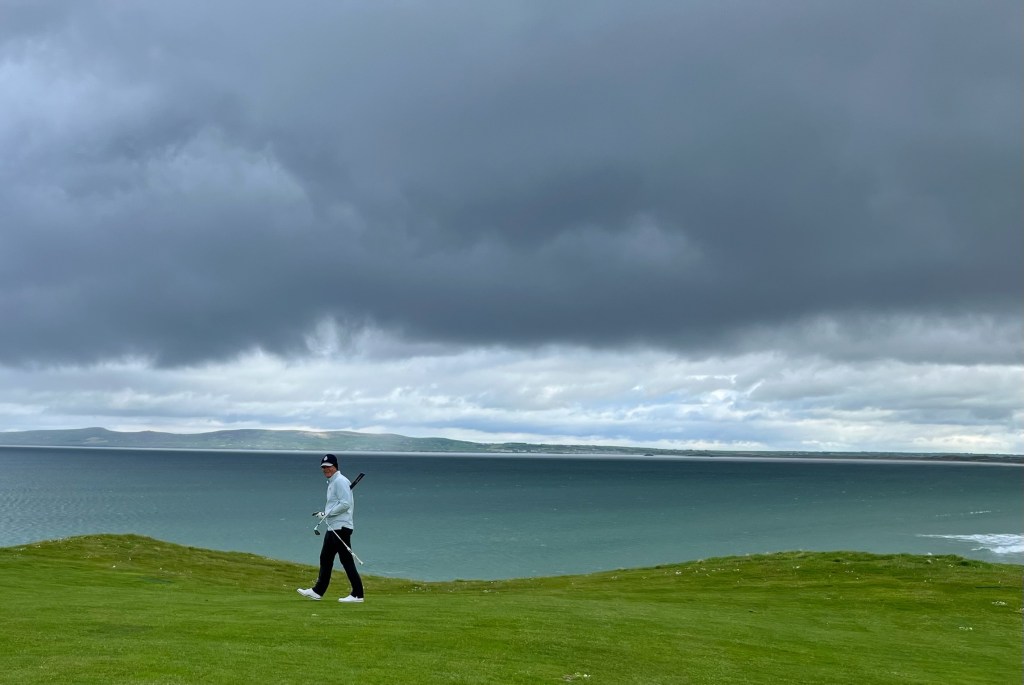
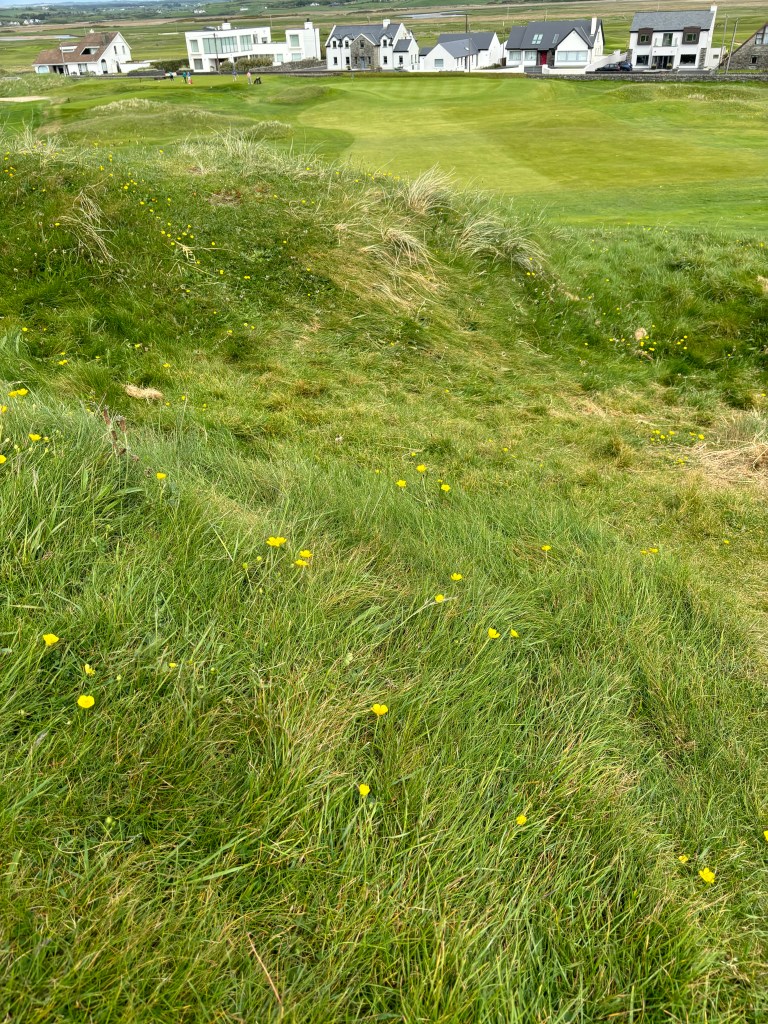
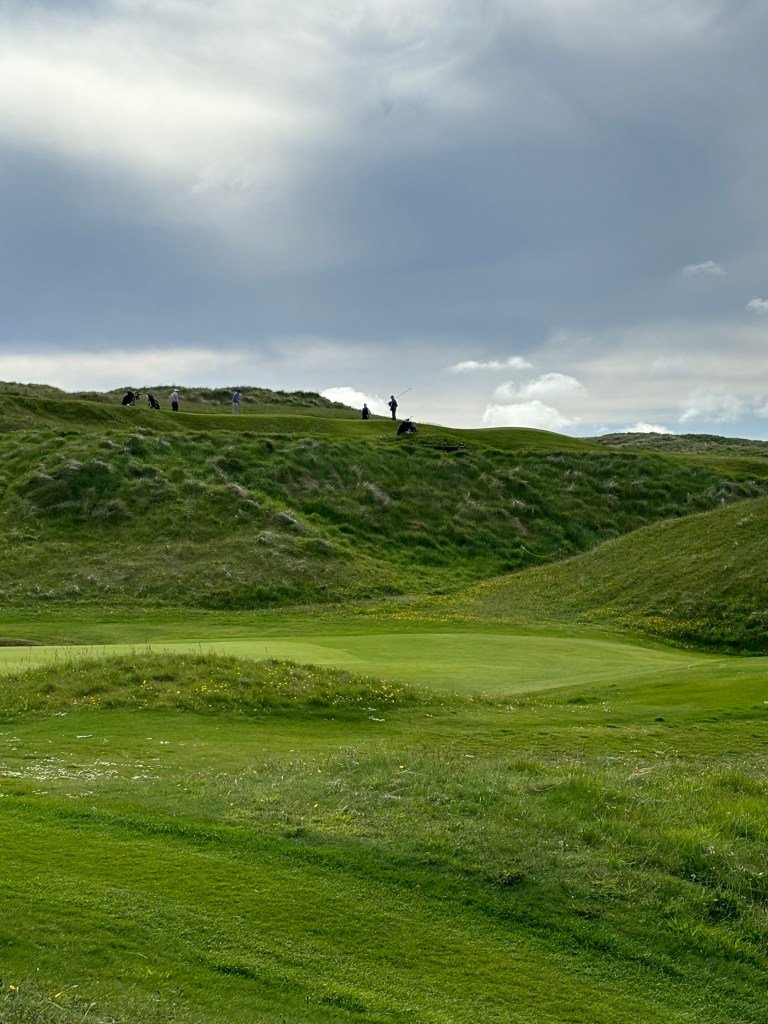
The course runs along the Irish Sea and up and down a series of dunes.
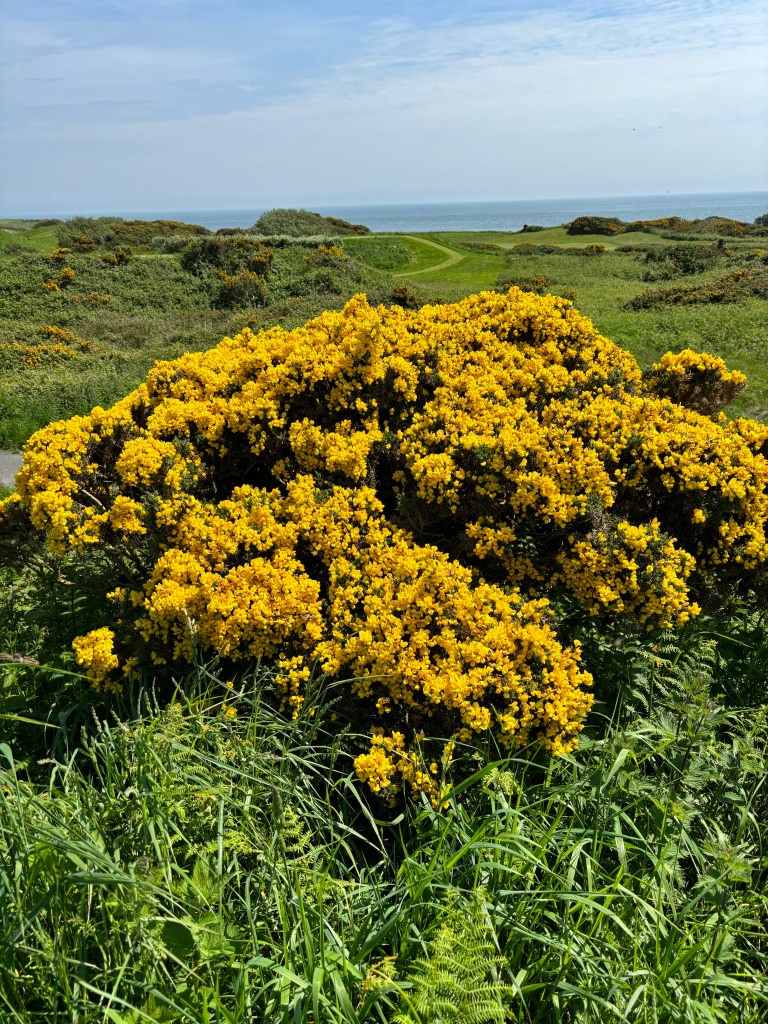
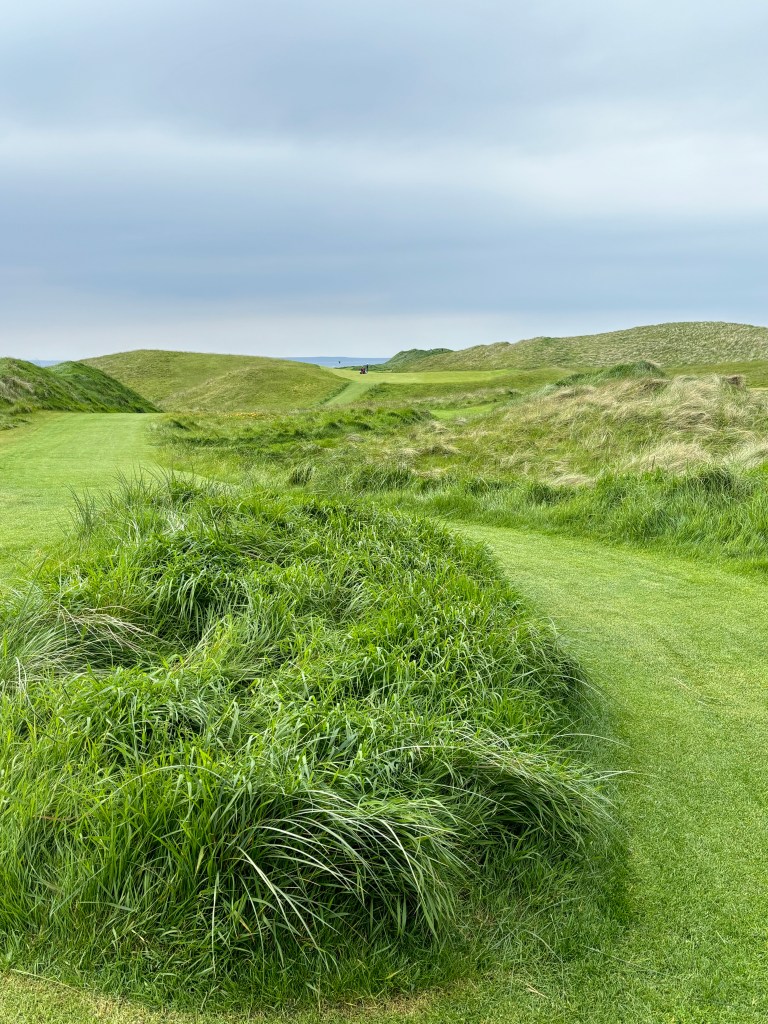
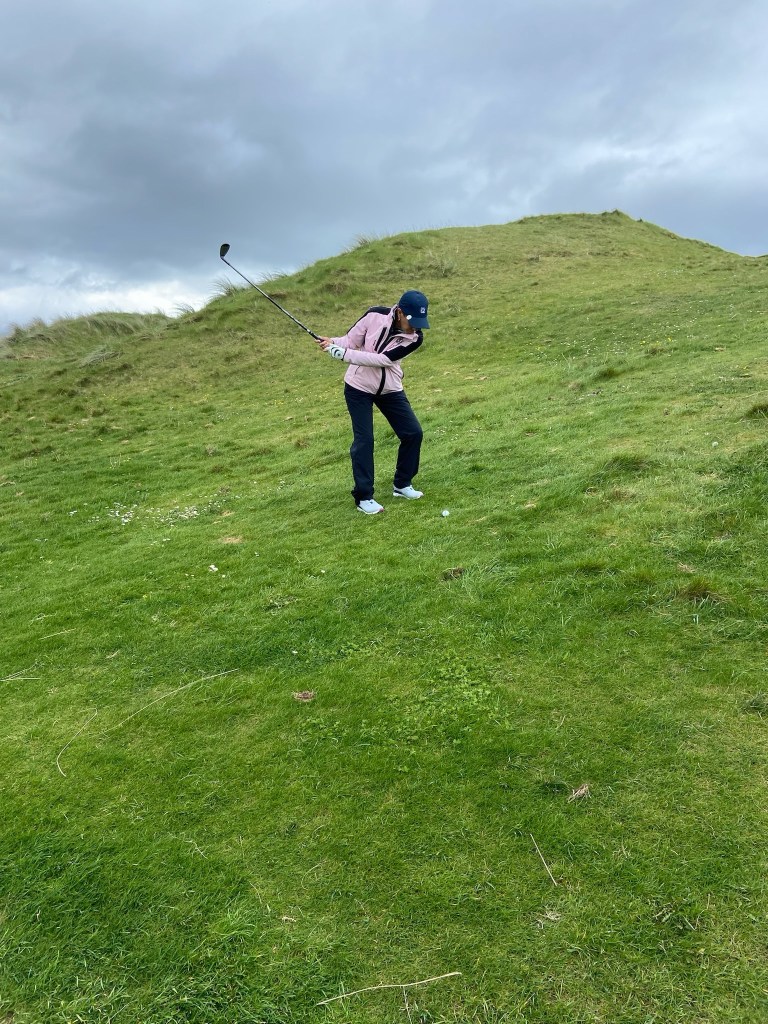
The flowering season of the gorse is coming to an end but one bush in particular was incredible. A beautiful but viciously thorny plant that attracts golf balls.

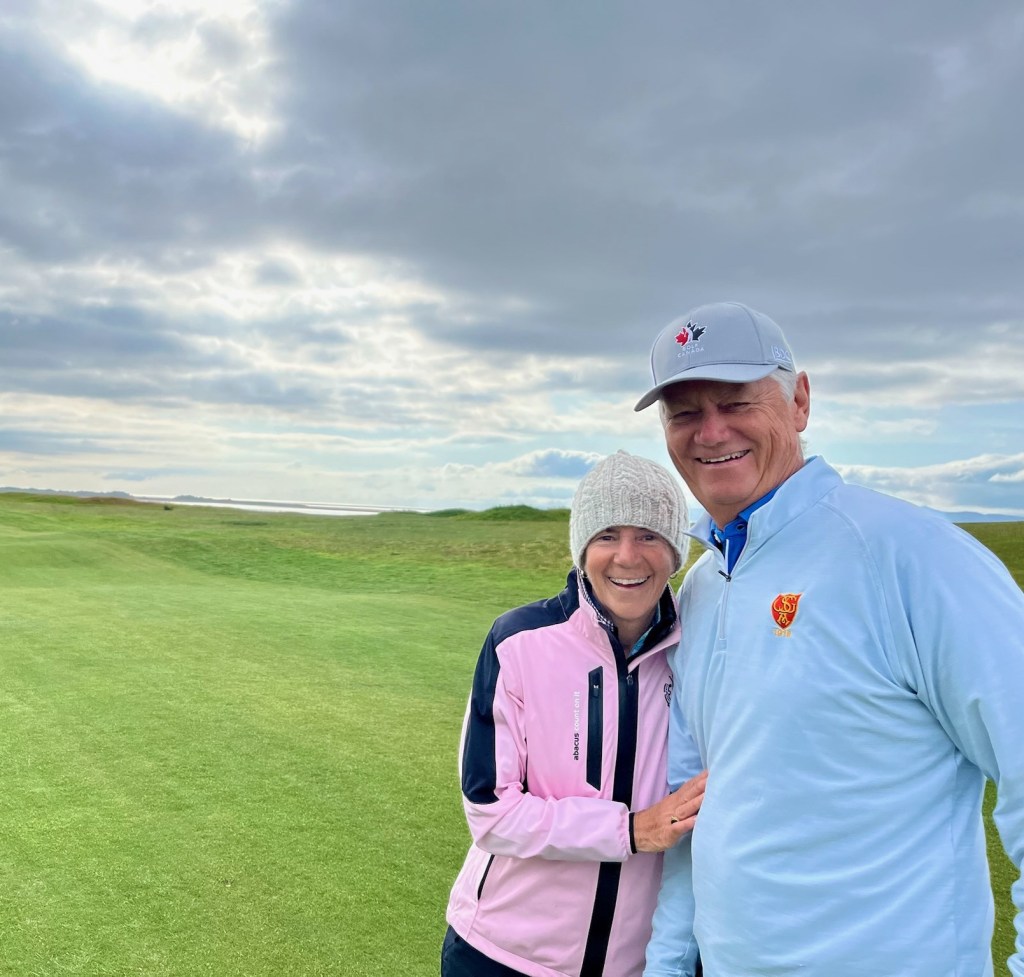
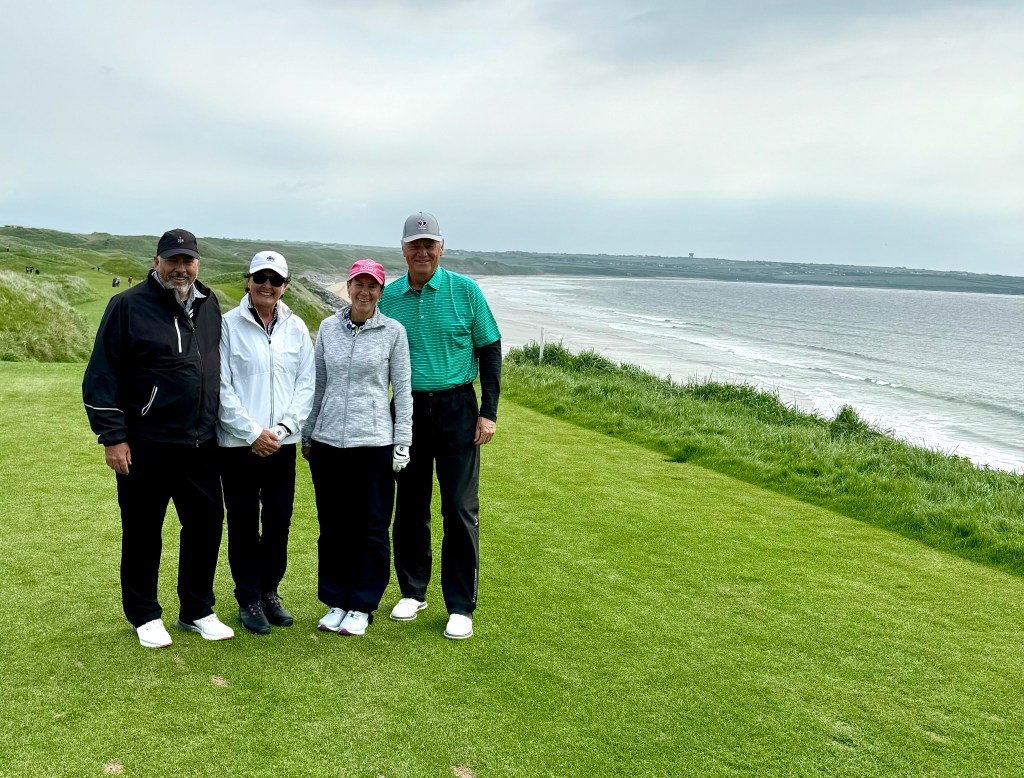
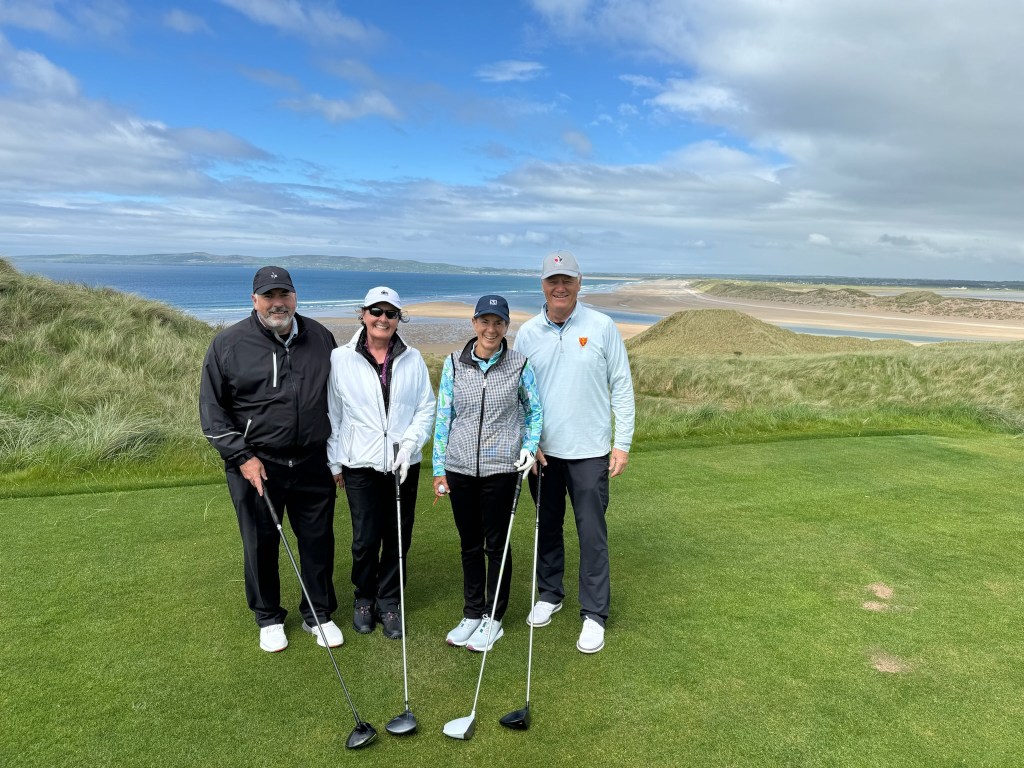
Just a twosome meant a selfie group shot
Just spectacular

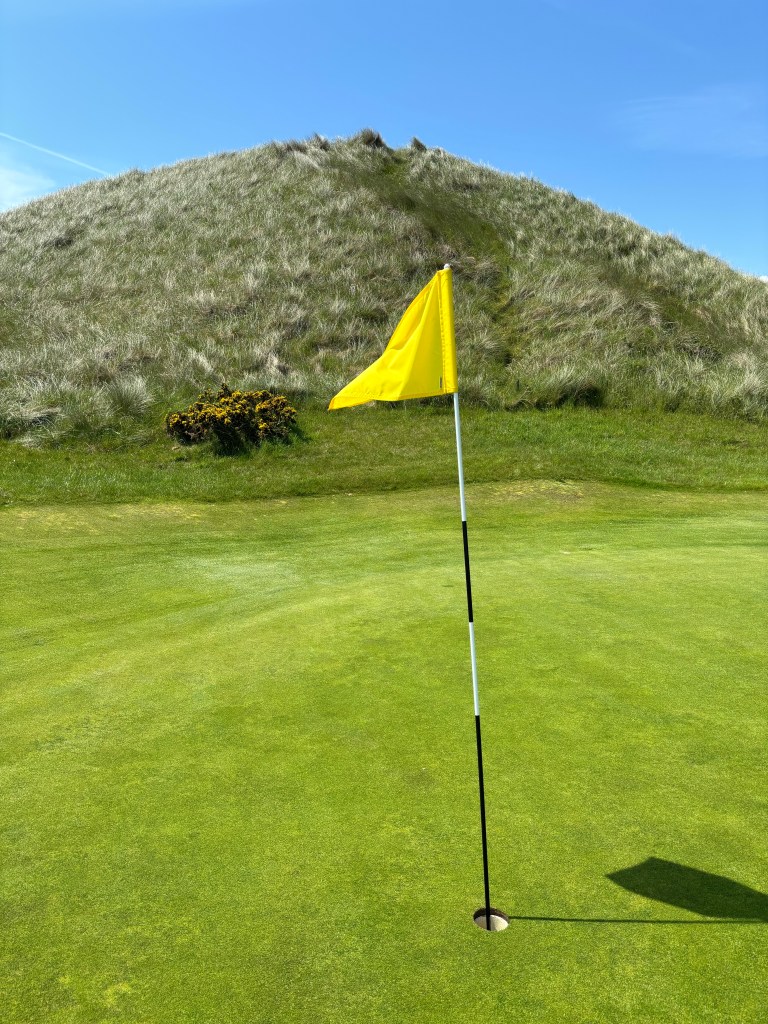
Because there’s enough land and, in Ruddy’s words, you can’t have too much golf, the course is actually 20 holes. There is a 7a and a 12a. Both are testing par 3’s that flow into the routing. Unfortunately we couldn’t pick our best 18 hole score at the end. Also, the 15th hole has the world’s longest green at 127 yards. Can you imagine the 3 putts?

And so ends our adventure. Fifteen links courses played in 20 days. Add in the Pit days and our extra long weekend in Dublin at the start and it’s been nearly a month of unique sights and experiences. Thanks to P&G for helping make this a wonderful trip.

And we’re already planning the next one. Australia sand belt courses here we come. Stay tuned – spring 2025.

Kilkenny

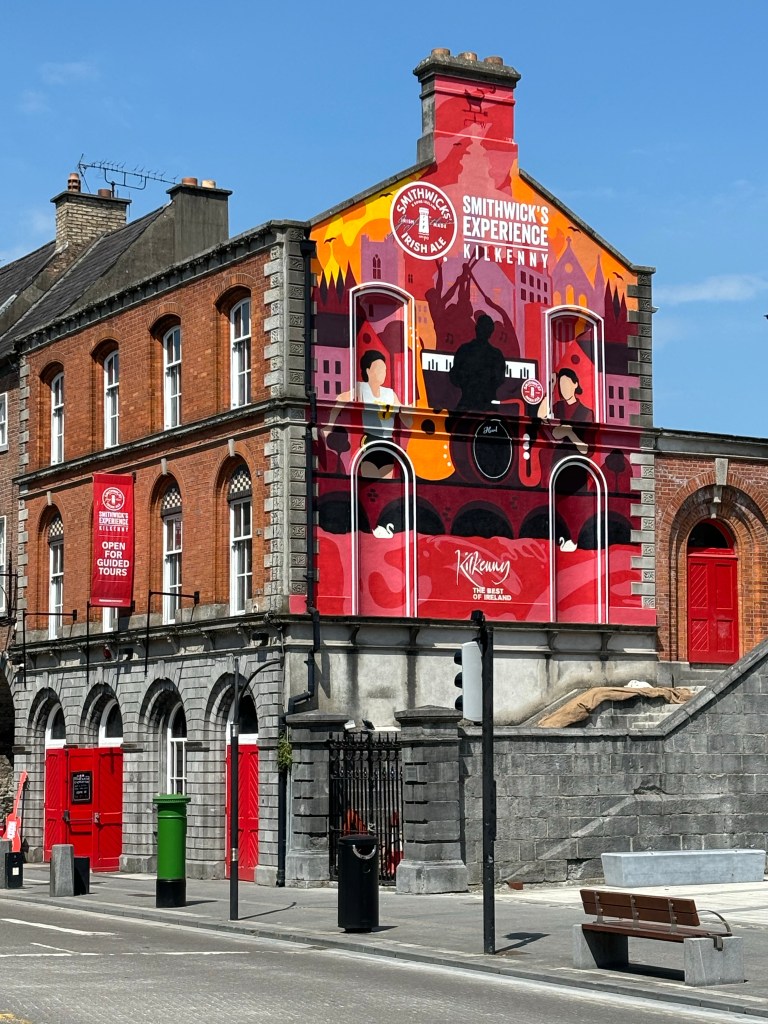
We chose Kilkenny as a Pit Day destination as it is about 60% of the way back to Dublin, is home to a famous castle and the birthplace of Smithwick brewing.

Packing up Killarney was fairly simple – just toss it in the car, we’ll figure out how to squeeze it into a suitcase/golf bag later kind of packing. As P&G have their own car we set off separately for the 2 1/2 hour drive which was carefully mapped out to ensure M and N highways only. Still searching for road shoulders though.

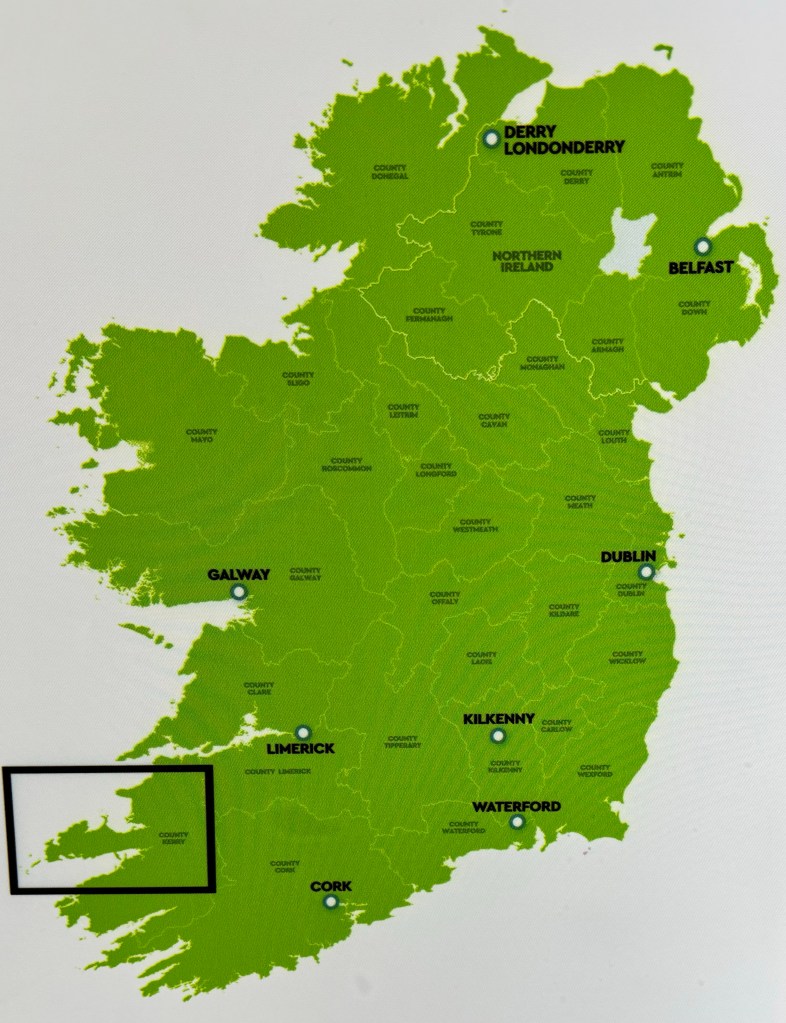
Our drive took us out of County Kerry, through a portion of County Cork and across the edge of Count Tipperary and into County Kilkenny. So for a short time we were not a long way to Tipperary (couldn’t resist).

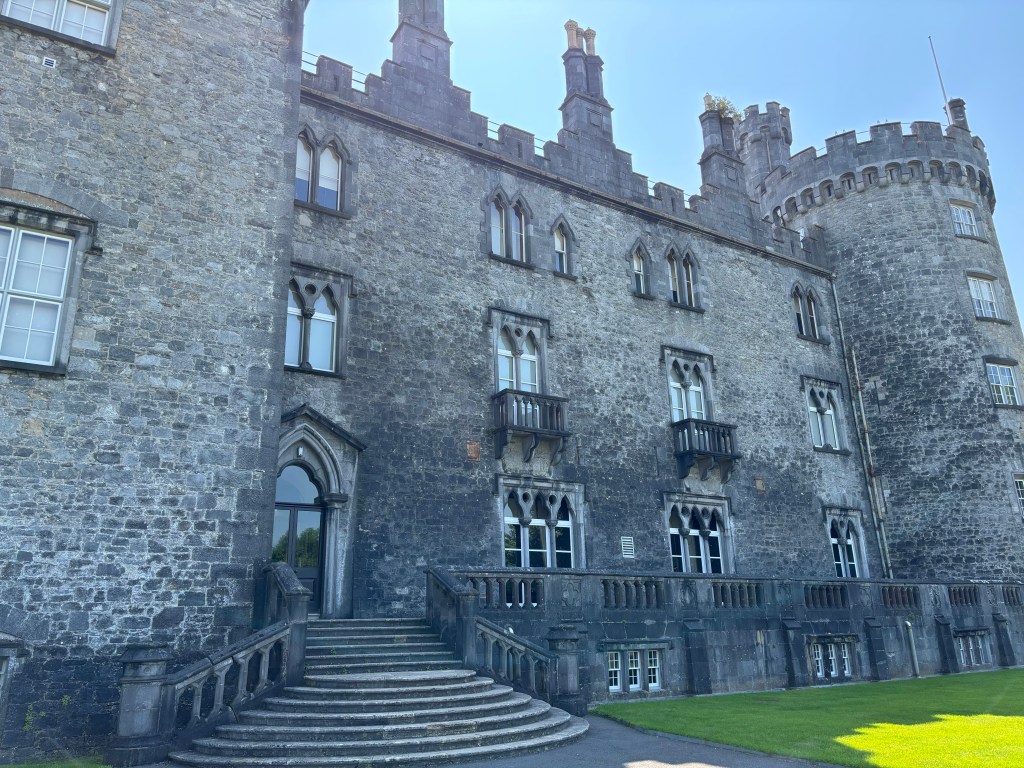
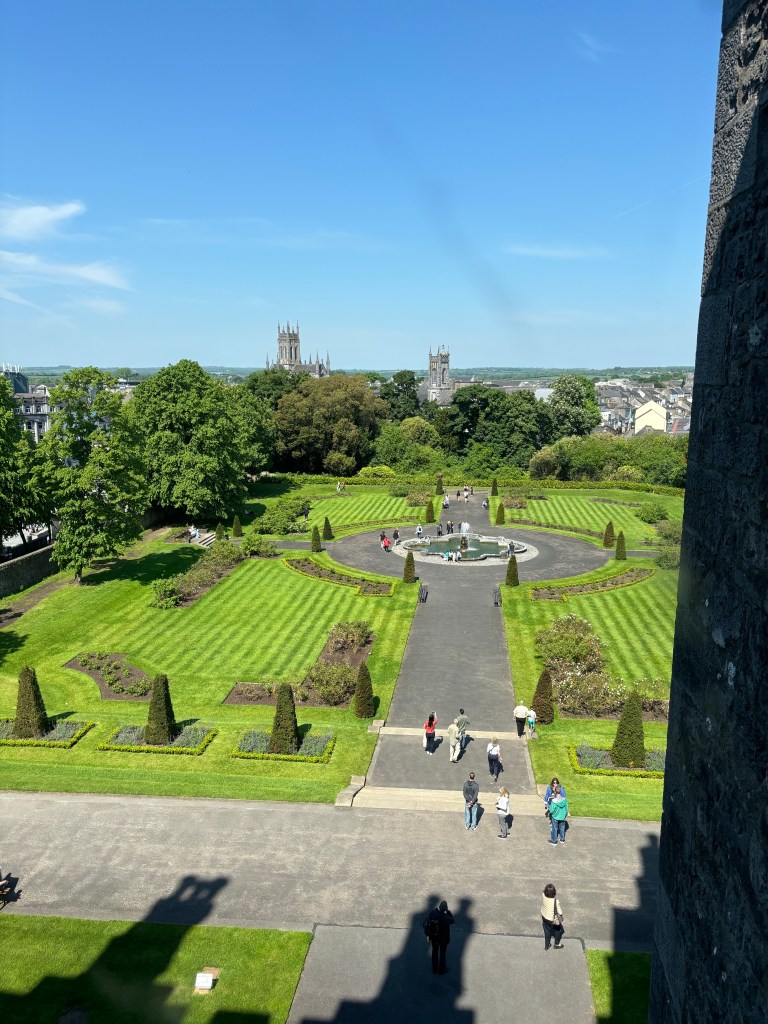
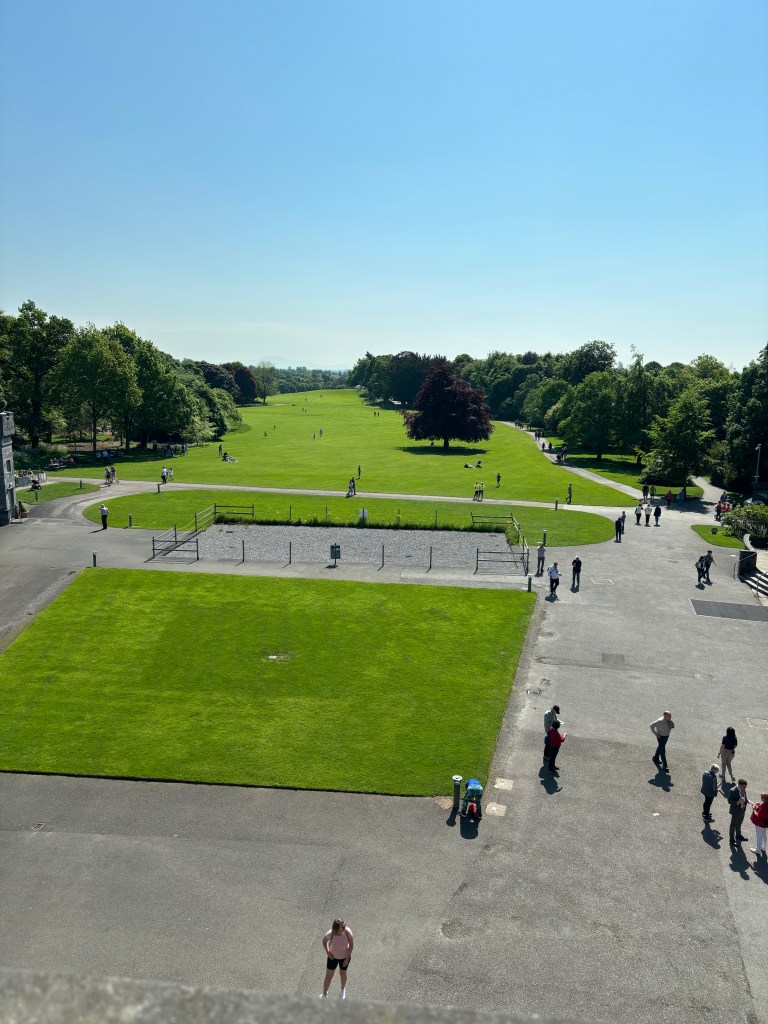
Bright, warm, short sleeves sunshine greeted us in Kilkenny which sits on the River Nore and was a a key center of Norman domination in the 13th century. Kilkenny is a tourist destination and its environs include two castles, two cathedrals, two abbeys and other historic structures. Kilkenny Castle lords over the city, literally.

The castle dates from the 13th century but has undergone many internal renovations and restoration. It was originally four sided but the east wall and the northeast tower were damaged in 1650 during the siege by Oliver Cromwell and were later torn down.

The Butler family, under the hereditary title Duke of Ormond, lived in the castle for more than 700 years. George Butler, 5th Marquess of Ormonde, lived in the castle until 1935 when estate taxes and other costs lead to its abandonment. It sat vacant for more than 30 years and was sold to the city for £50.

The restored rooms that we toured reflected the period from the mid 1800’s to the early 1900’s.

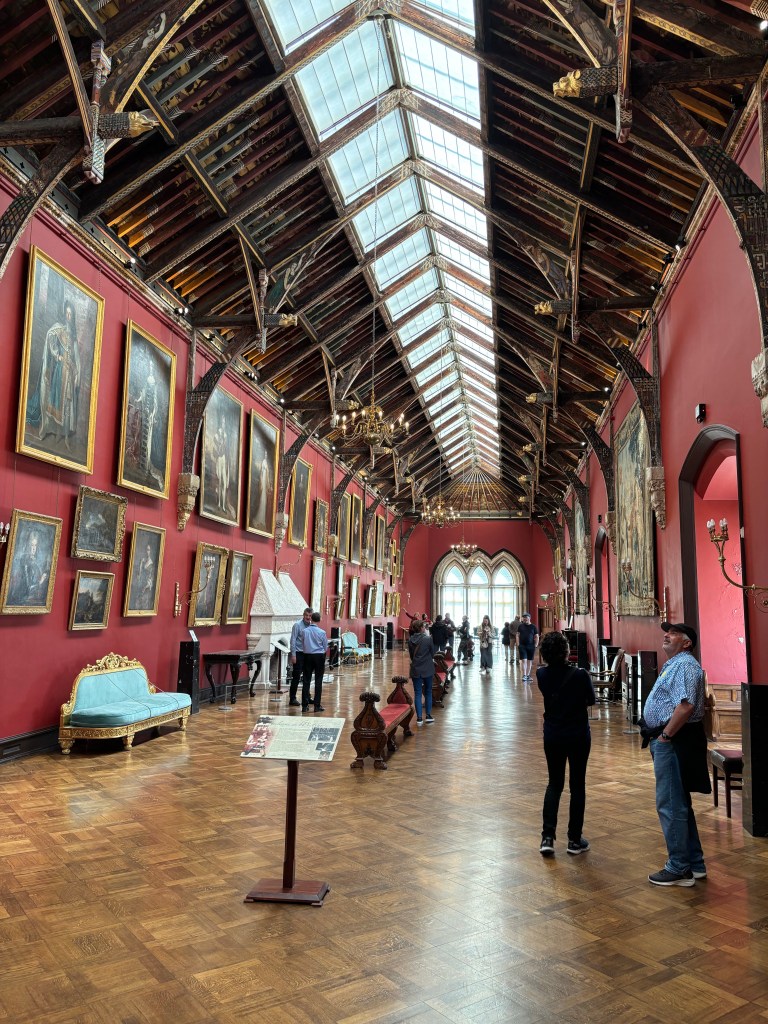
The Portrait Room

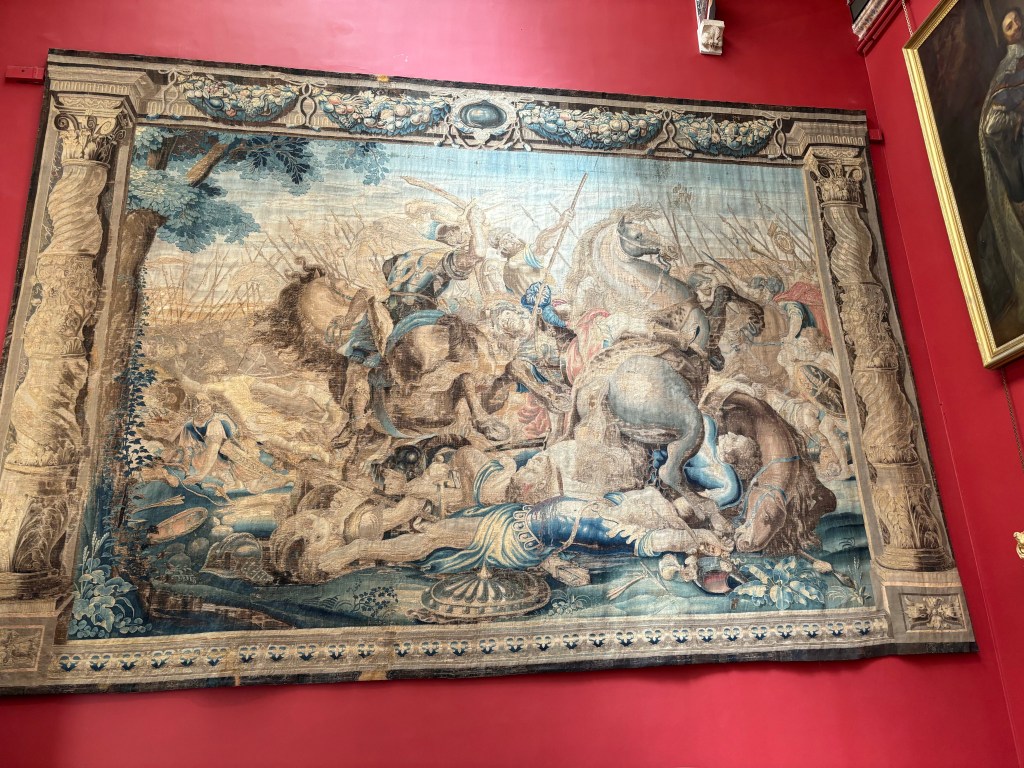
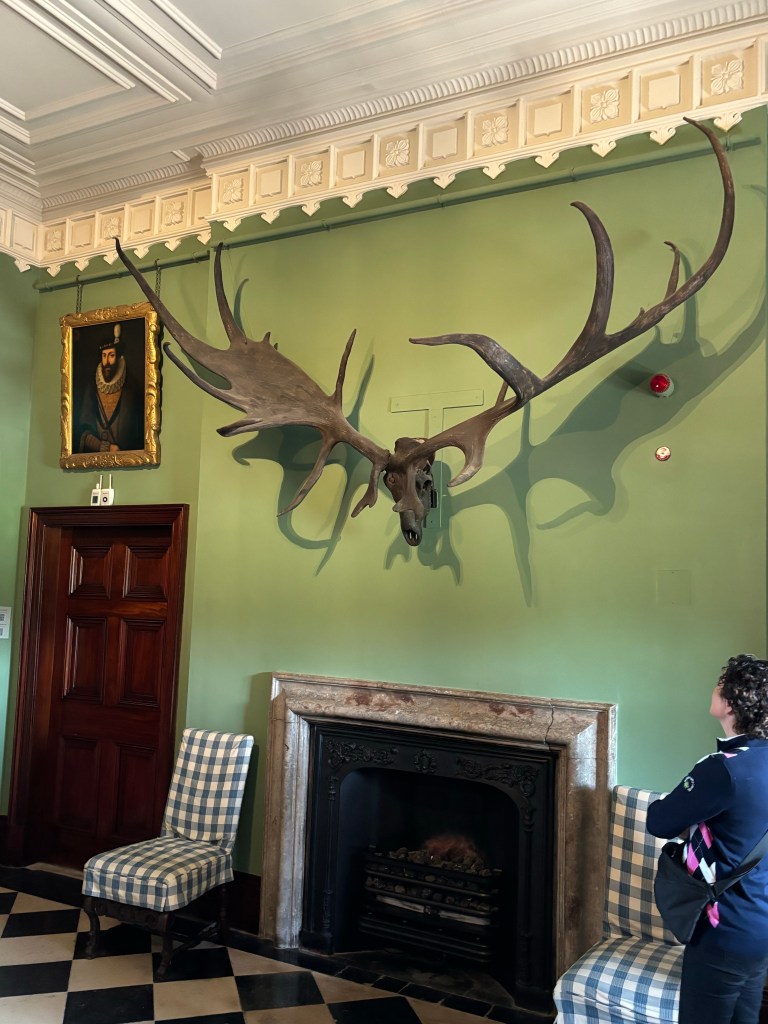
Our guide took us up and down stairs in the different towers, described some of the hundreds of paintings and portraits, and explained how different parts of the castle had been used.

We then walked the medieval mile down the hill past numerous shops, pubs and restaurants on our way to the Smithwick brewery.

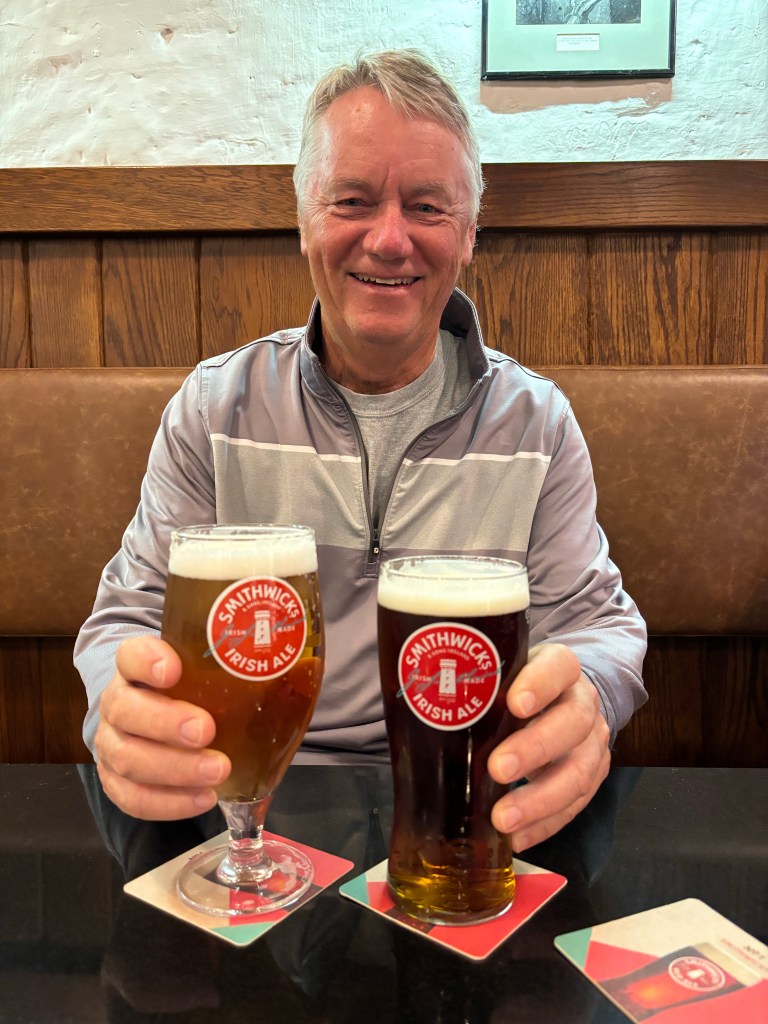
An entertaining guide took us through the brewing process while providing a history lesson of the Smithwick family and the beers they made. Very informative and interesting. The tour ended on a positive note.

Settled in to a very nice hotel, dinner and an early night. P&G will do some more exploring tomorrow before heading back to Dublin. M&M are off to the European Club on the east coast for one last round of golf before we link up again in Dublin. Then the real packing test will be on.

Dooks GC

Our final round as a foursome (M&M have one more before flying home next week) took place at Dooks. Golf has been played at Dooks since 1889 which makes it one of the oldest golf links in Ireland. For nearly 100 years the links remained a quirky, 9 holes monument to those early days as the members resisted all efforts at modernisation. It was extended to eighteen holes in the 1970s under the guidance of Eddie Hackett. The course was further renovated in 2002 by Martin Hawtree.

The famous Dooks logo – a Natterjack Toad

We would concur with the description that Dooks is infinitely easier compared to nearby Tralee and Ballybunion. Its front nine is set on links land with moderately high dunes while the back nine turns into a little more parkland terrain. There are some robust holes however including one 451 yard uphill into the wind par 4.

The sedate atmosphere after the commercialized bustle of Ballybunion was welcome given it was our 14th round in 19 days. The fairways were generous and the first few yards of rough allowed balls to be found AND played.

Well perhaps not always.

Dingle Bay is in view from practically every point on the golf course

Yet again we had fabulous weather although the breeze off the water meant an extra layer at times. Other than our opening round three weeks ago we have avoided rain on every golf course. Even the locals are impressed.

Our day finished in the early evening as more cloud cover rolled in. Tomorrow we pack up early in Killarney and make the trek east to Kilkenny for our last group Pit Day.

Ballybunion

As American sports announcer Keith Jackson said of the Rose Bowl, “welcome to the granddaddy of them all.” Ballybunnion Old Course exudes a majestic feel that simply cannot be compared. A James McKenna design first laid out as 12 holes in 1893, was summed up in an 1897 news story as, “a rabbit warren below the village, where a golfer requires limitless patience and an inexhaustible supply of golf balls.” More than a century later such an observation may still hold true.

Our day included a bit of an early wobble as the crack backseat navigation team lobbied for a route not suggested by GPS. Welcome to 20 minutes of unanticipated “L” roads. Upon arrival we were then informed no caddies or electric trolleys were available due to a full tee sheet. Without other options we set off with old fashioned small wheel pull carts.

At the last minute an older caddy just finishing his morning loop was convinced by the starter to head out again with us. M&M volunteered to push/pull so he managed P&G’s bags. Not ideal but sufficient guidance was provided to all as we went around. Given the hills and wind, needless to say that Brendan was completely knackered at day’s end.

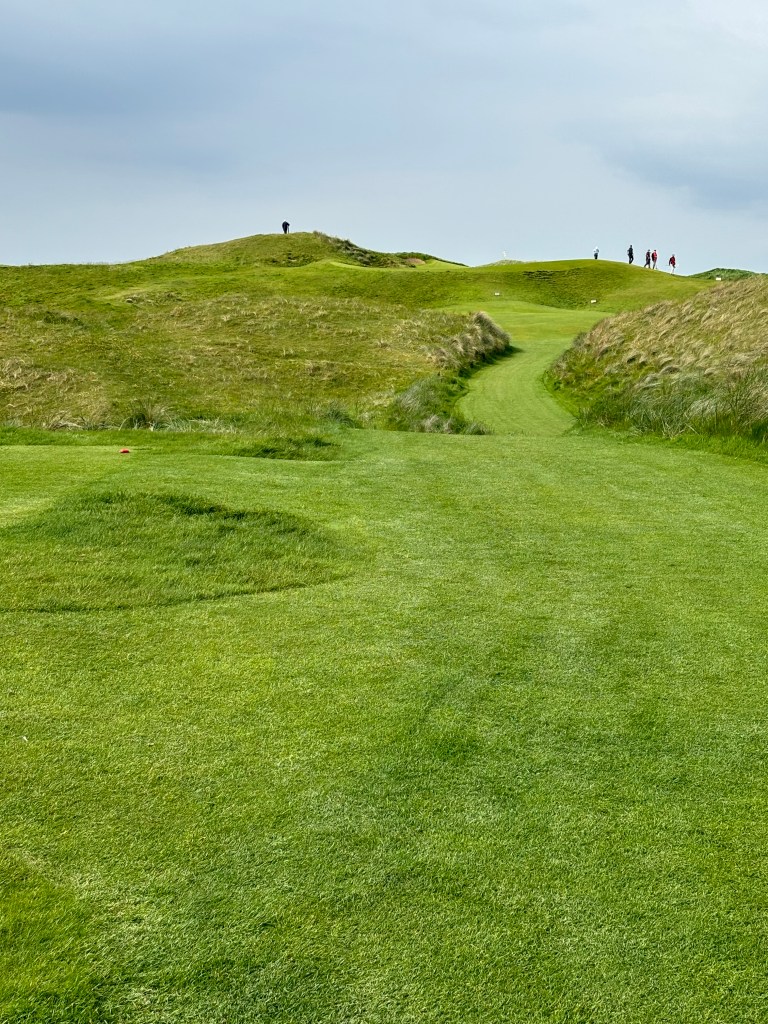
The course starts with a bang as you have to avoid a cemetery with the opening tee shot and then climb your first steep hill on #2.

Five of the first six holes played into a fresh breeze which meant an extra clothing layer and an extra club or two.

The sixth and seventh holes occupy the flat, north end of the property with the latter playing along the ocean’s edge.

Then it was back into the massive dunes where each hole required fairly precise shots both off the tee and certainly to the green.

Sometimes a search party was called into action.

And so it went. Every hole demanded accuracy otherwise the scores mounted (no pun intended).

Our good fortune weather wise continued and clothing layers came and went.

The wind was such that on two par threes on the back nine, Driver was required. Curiously, one such hole for the ladies played as a par 4 on the scorecard.

Par 3 uphill 215 yards into the wind – Driver!!

And if wind, dunes, knee high grass, hills and fatigue weren’t enough other hazards came into play.

Looking back down #18

We concluded Ballybunion’s reputation was accurate and well deserved. Not overtly penal yet relentless in avoiding having any weaknesses or soft holes. Definitely a need to play again course to unlock the proper angles and approaches. A thoroughly enjoyable day.

Waterville

Our routine includes reviewing a variety of different weather apps trying to discern what golfing wardrobe will be necessary the following day. Waterville did not look good with rain likely the entire day. We woke up to sunshine in Killarney and hoped for the best.

Waterville is on the western edge of the Ring of Kerry. We had the option of being part of a tourist convey of cars on the ring taking 90+ minutes or going straight through the middle of the peninsula (or over the mountain as the locals say). The latter indicated a time saving of over 30 minutes so off we went despite the uncertainty of what we would face.

Well that was a mistake! It was whatever is below an “L” in the roadway hierarchy.

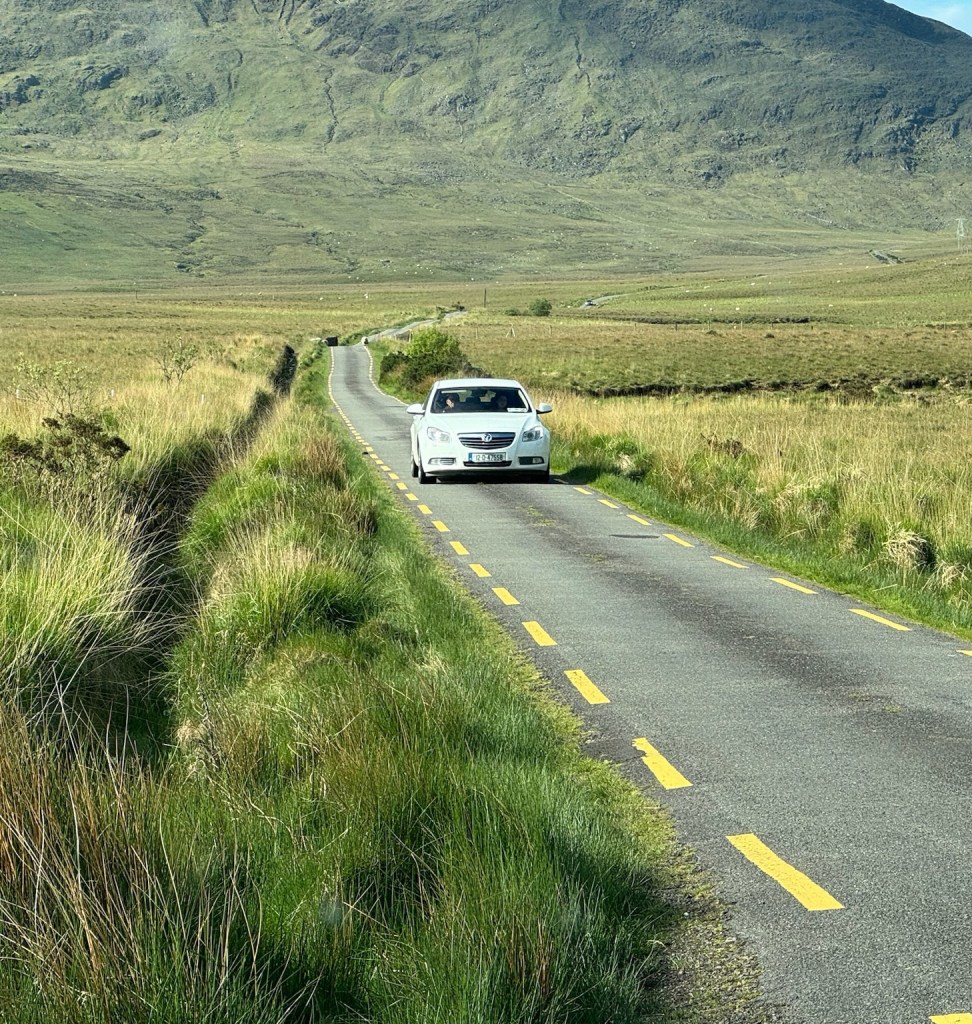
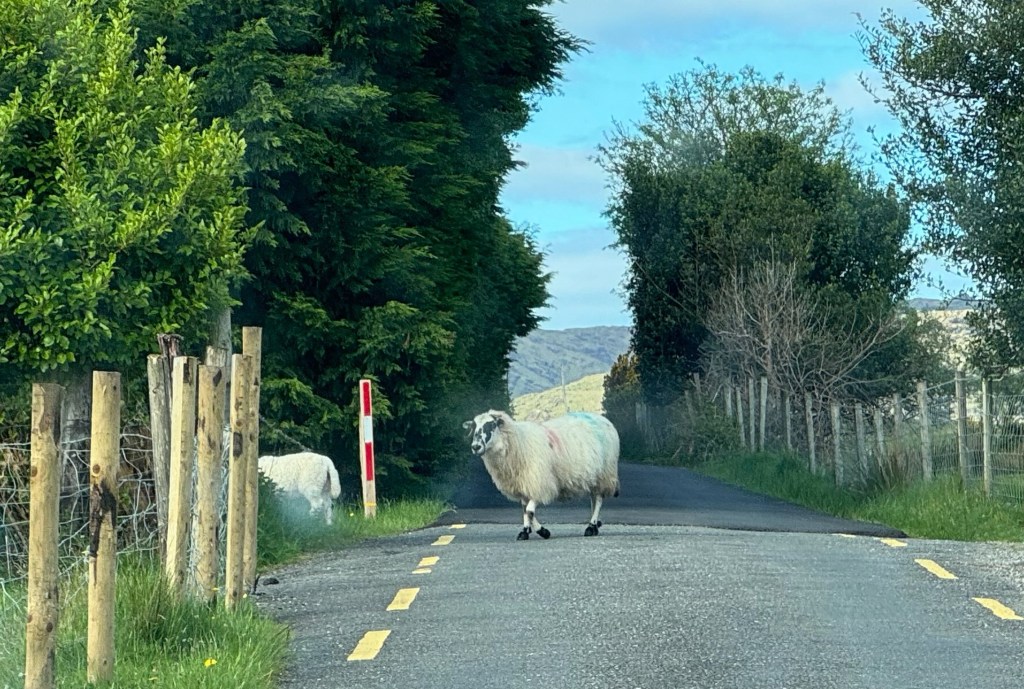
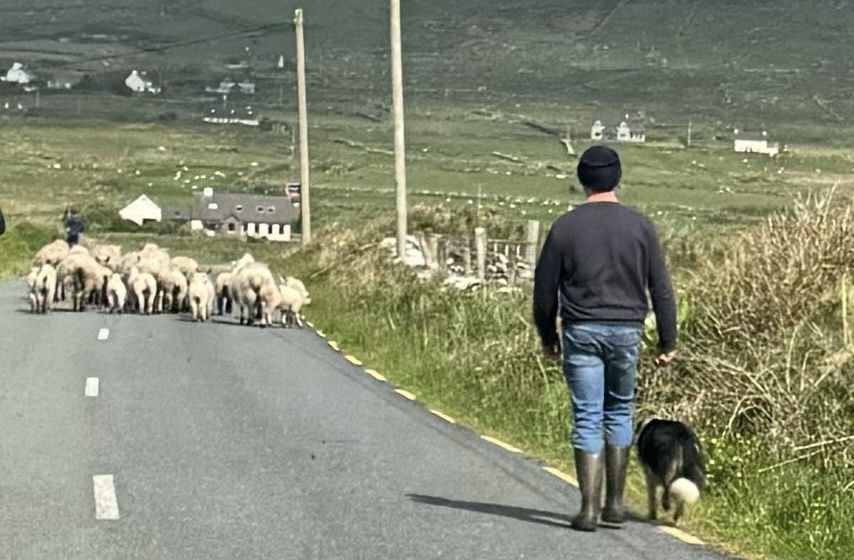
Fortunately we only had to deal with a few oncoming cars which meant finding a sliver of space to the side. And apparently, sheep have the right of way.

Our fears about the weather hadn’t materialized upon arrival and in fact the sun shone brightly.

The earliest golf at Waterville has been traced back to 1889 where a modest nine-hole layout occupied the flat eastern section of the present championship links. In the early 1970’s the original nine holes were reconfigured and expanded by Eddie Hackett to create today’s front nine with the full 18 opening in 1973. Tom Fazio subsequently redid the course by changing thirteen holes and building two new ones, finishing up in 2006 by making further amendments to two more.

The Hare features in the logo due to a large population of the real thing on the golf course – we didn’t see any

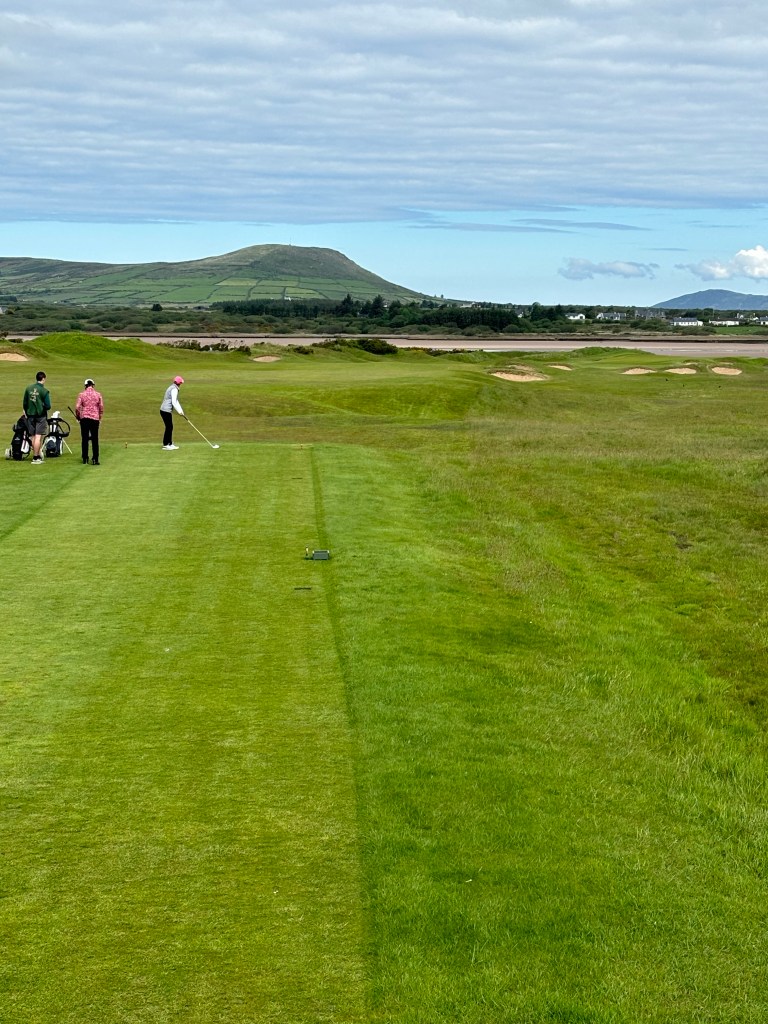
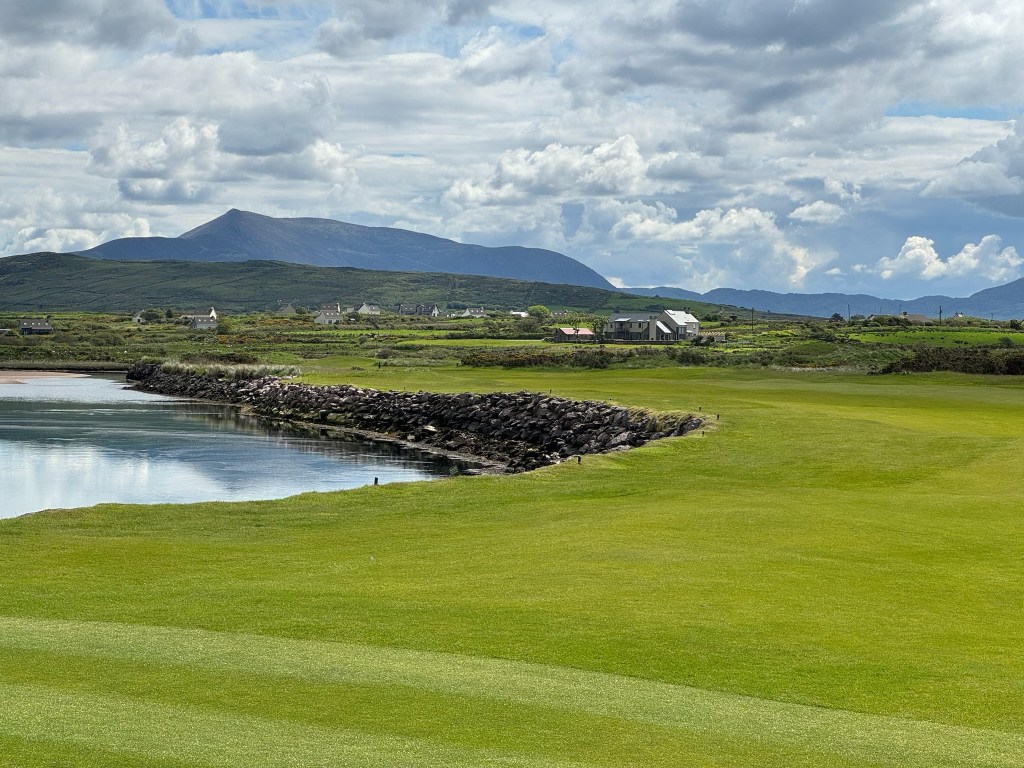
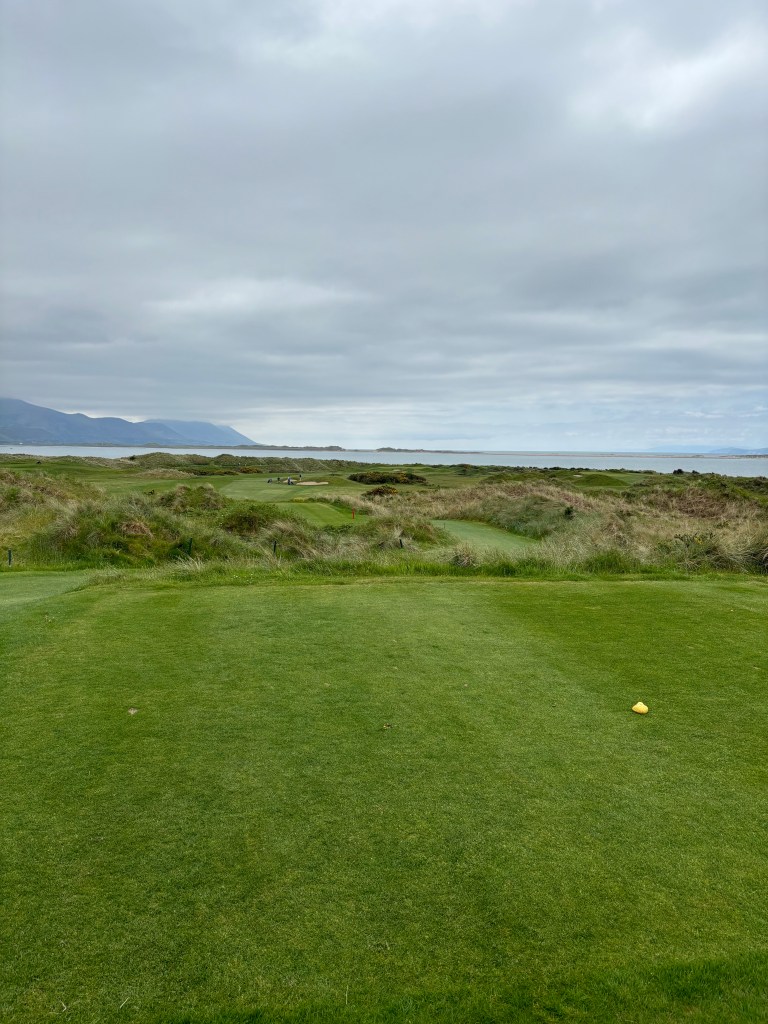
It’s difficult to describe Waterville as we all initially questioned why it has such a stellar reputation. Perhaps it was because it was very subtle and not punishing in the manner of other courses we’ve played. Its unique location on an isthmus bordered by the Atlantic Ocean, the Inny river, the Inny Estuary and native bogland provide an open view and feeling of space. Fazio talks of the unique routing with the front nine mostly flat with no imposing dunes.

The back nine more than makes up for this with very strong holes having elevation changes, big dunes and many more pot bunkers.
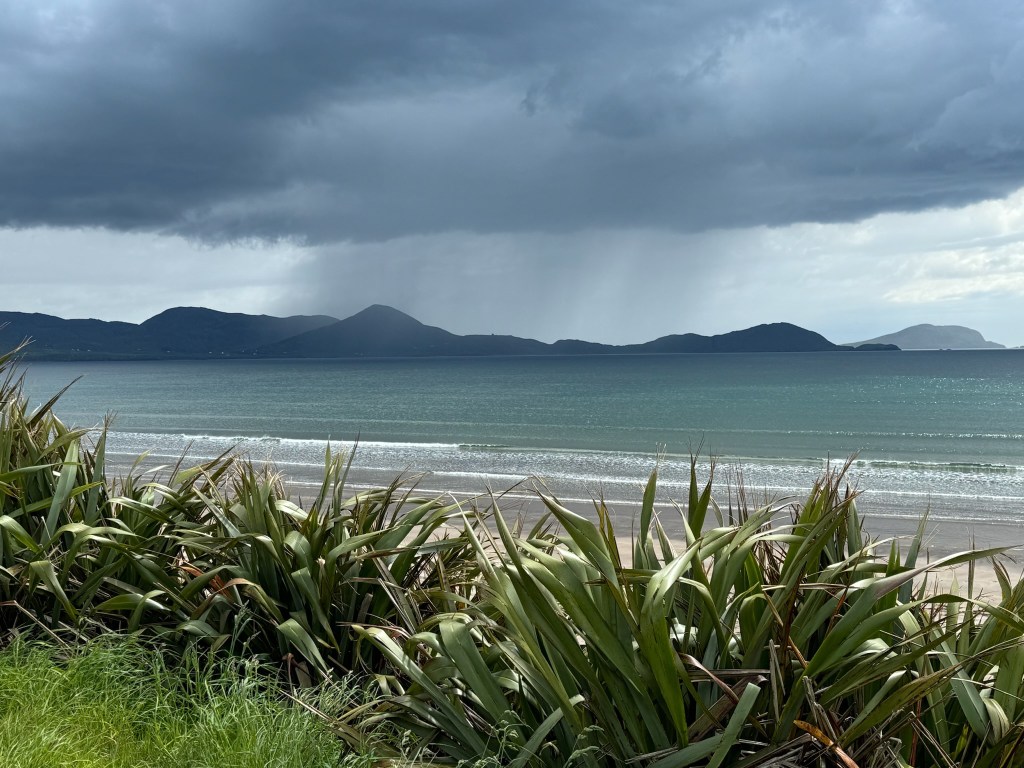
Still it never felt that a small miss would end in disaster. Balls actually rolled away from bunkers and bounces off hillsides found the fairway.

The sun continued to shine although rain storms were on the horizon. We even witnessed a special cloud formation – directly above Peter!

The rain threatened but never arrived

Collectively we agreed Waterville was enjoyable and playable but less dramatic in both design and vistas versus our previous stops.

Oh, and we drove home on the Ring whose roadway felt like a super highway in comparison to the morning drive. Ballybunion Old Course tomorrow. Truly a global icon awaits.

Dingle Peninsula

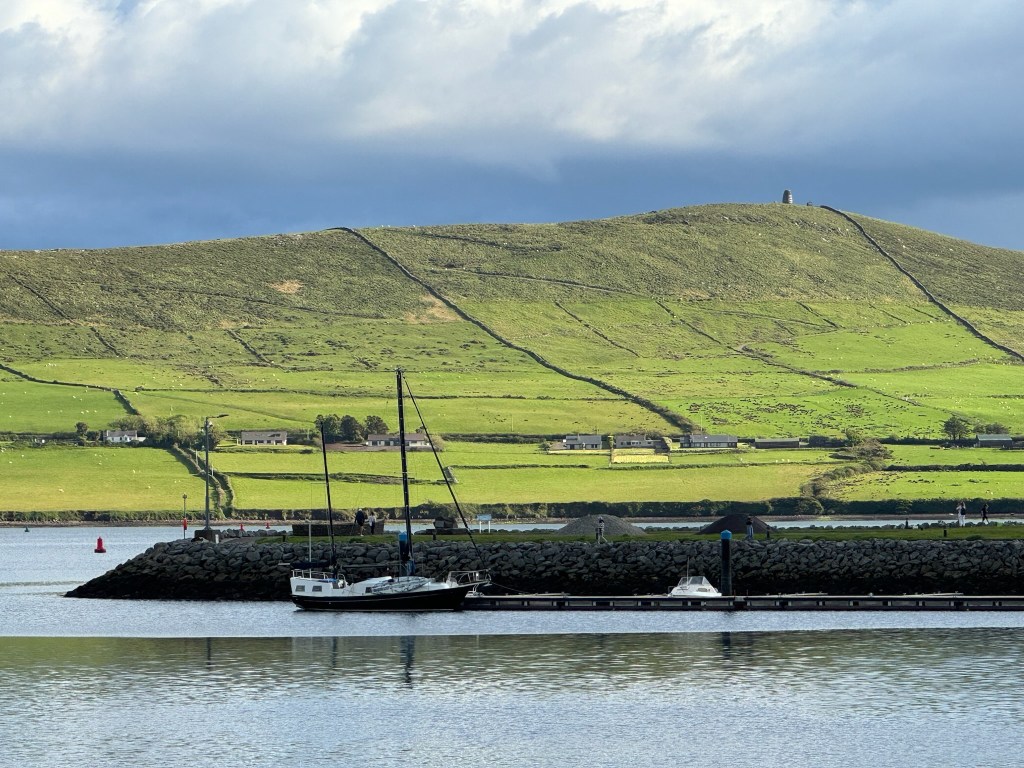
The promontory north of the Kerry Ring is the Dingle peninsula. Not as famous as its southern neighbour it still offers compelling sights and history lessons combined with its namesake hopping tourist town.

Dingle Peninsula

The formal name is Slea Head Drive and like the ring it is strongly suggested one drives in a clockwise direction to limit encounters with other idiots errr, tourist cars and buses.

We set off in a very heavy rain storm with Peter at the wheel despite it being his birthday. We learned another aspect of the Irish road system. The “N” has been previously described. Below that is the “R” series which generously includes, most of the time, a painted centre line albeit with an inconsistent road width for two cars. Today it was welcome to the next level down, the “L”, which is lineless, one point something cars wide and challenging. We endured a short L spell just to get onto the peninsula and thought, whew, that’s done. Little did we know!
No matter the weather it’s beach time

The weather alternated between rain and sunshine which only emphasized the incredible pallet of different greens on the hills and valleys.
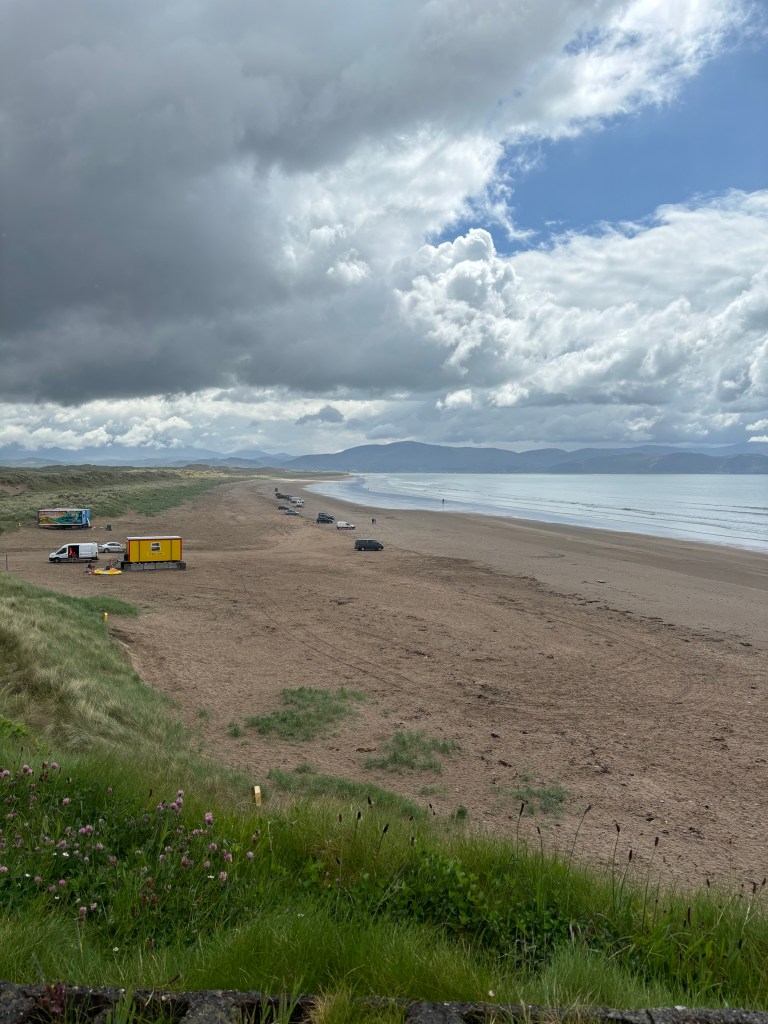
With the changing conditions it meant quick photo stops and then back into the car.

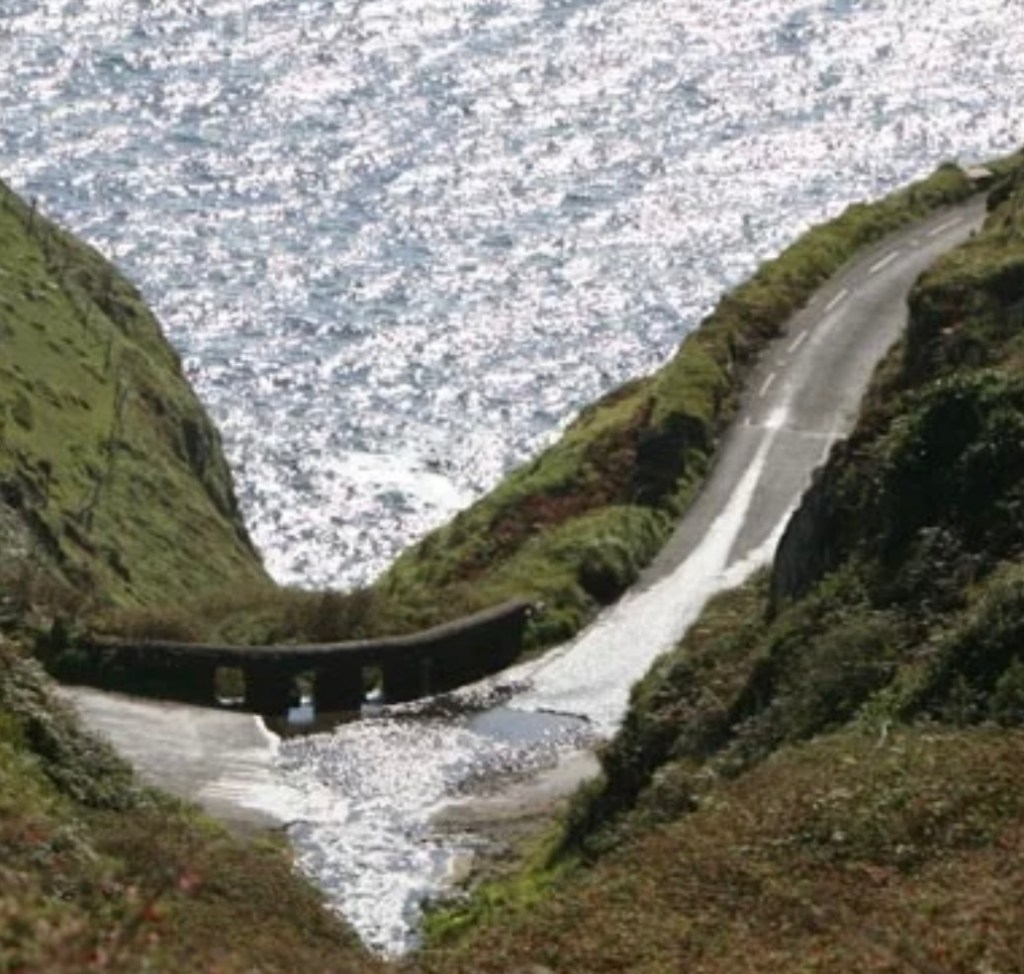
Past the town of Dingle, which is the start and terminus of the Slea Head Drive, the roads became more narrow as we went. Imagine nearly losing the outside mirror on the right to a rock cliff while a small stone wall on the left is the only barrier between you and the north Atlantic. Add in an intentional fording of a small stream running down the mountain just because.

We stopped at the Blasket Island information centre to learn about this cluster of small islands three miles off the coast. It is difficult to imagine the challenges and hardship of living in such a place but generations did so until 1953 when the last of the villagers left. A short film captured how these rugged individuals found joy through song and storytelling while dealing with the ravages of the sea and weather.

A commemorative statue at the Center captures this in part.

The drive continued and as the sun broke through some incredible views emerged.

Our the way back to Dingle was delayed by another unique road hazard.

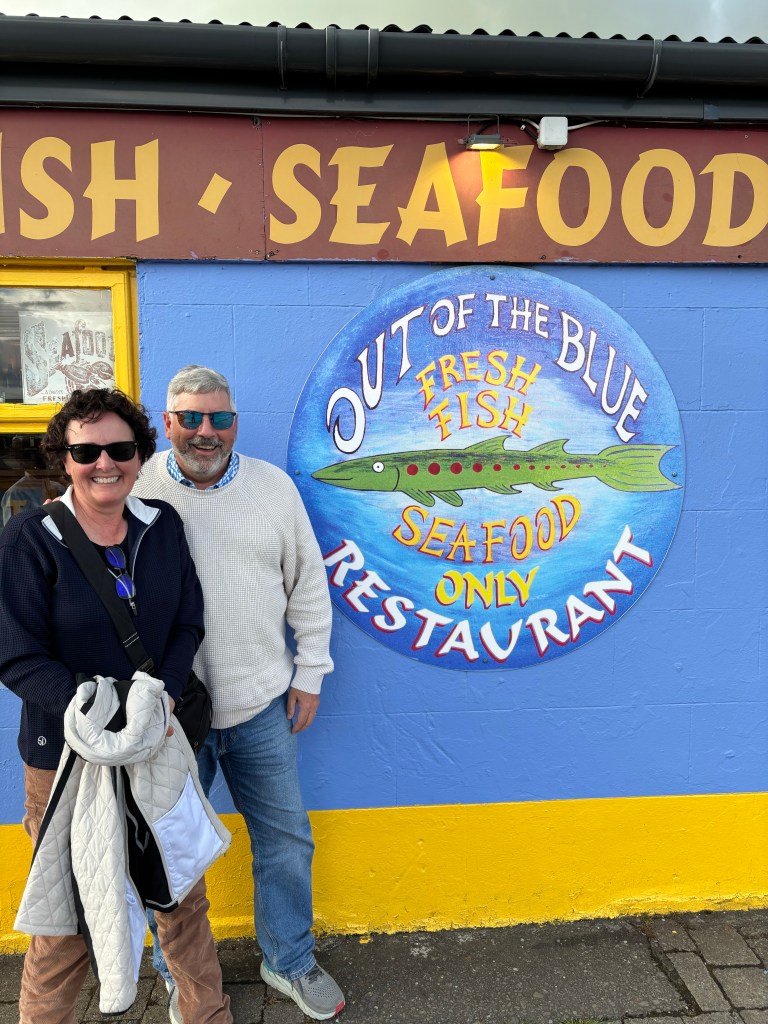
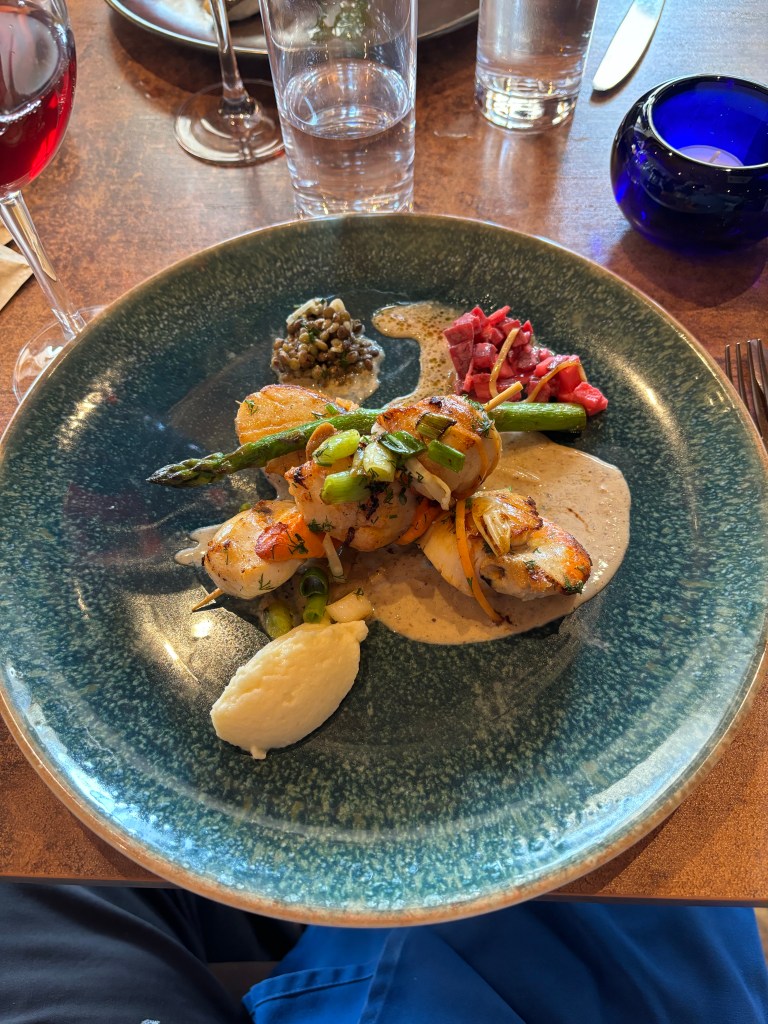
We celebrated Peter’s birthday in Dingle with a most amazing dinner. The building exterior would give you pause but inside is a Michelin rated restaurant that is outstanding.

I wouldn’t normally post pictures of food but it was that good.

A fun day capped off by a great meal. Tomorrow the long drive back down to Waterville GC at the tip of the Ring of Kerry. Fingers crossed given the weather forecast.

Ring Of Kerry

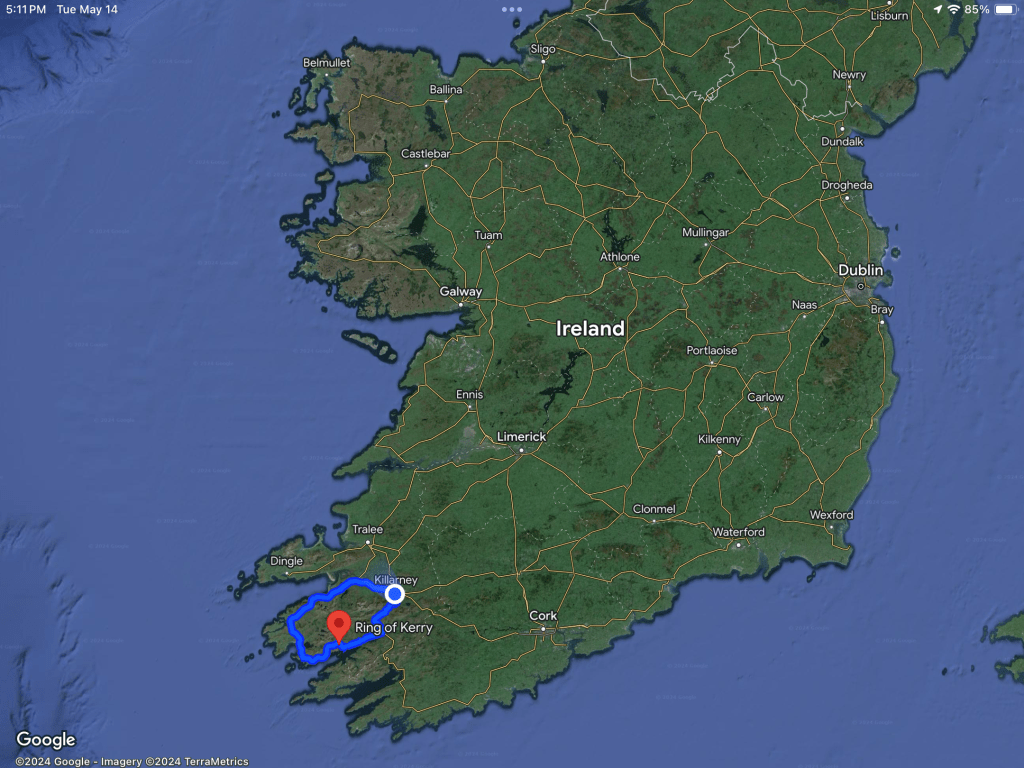
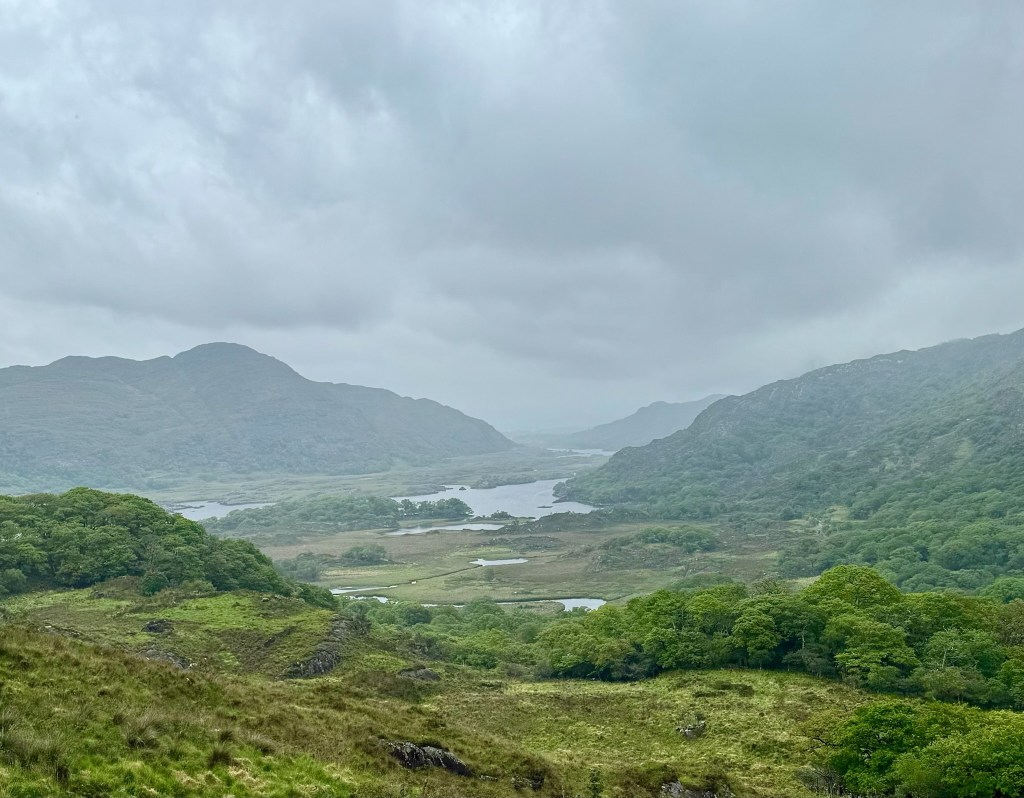
Our first of two consecutive Pit Days (I know, what were we thinking) had us driving a full loop of the Ring of Kerry plus the less traveled Skellig Ring at the very west end of the Iveragh Peninsula. Sadly the weather didn’t cooperate and we experienced a rainy, cloudy, grey day which detracted somewhat from the natural beauty of the area.

Ring Of Kerry
Oh so Irish

We knew in advance that the large touring coaches must travel counterclockwise hence our route was the opposite. Thus you go through Killarney National Park to get to the true start point at Kenmare. It’s 135 miles (217 Kms) to do the loop plus we tacked on another couple of hours on the Skellig Ring.

The map labels the Ring an “N” level road which normally means a modestly wide, two lane affair, minus, of course, any shoulders. With Peter at the wheel we would beg to differ as it was anything but normal. Lots of twists, blind corners and sections where there was a lot of collective breath holding.

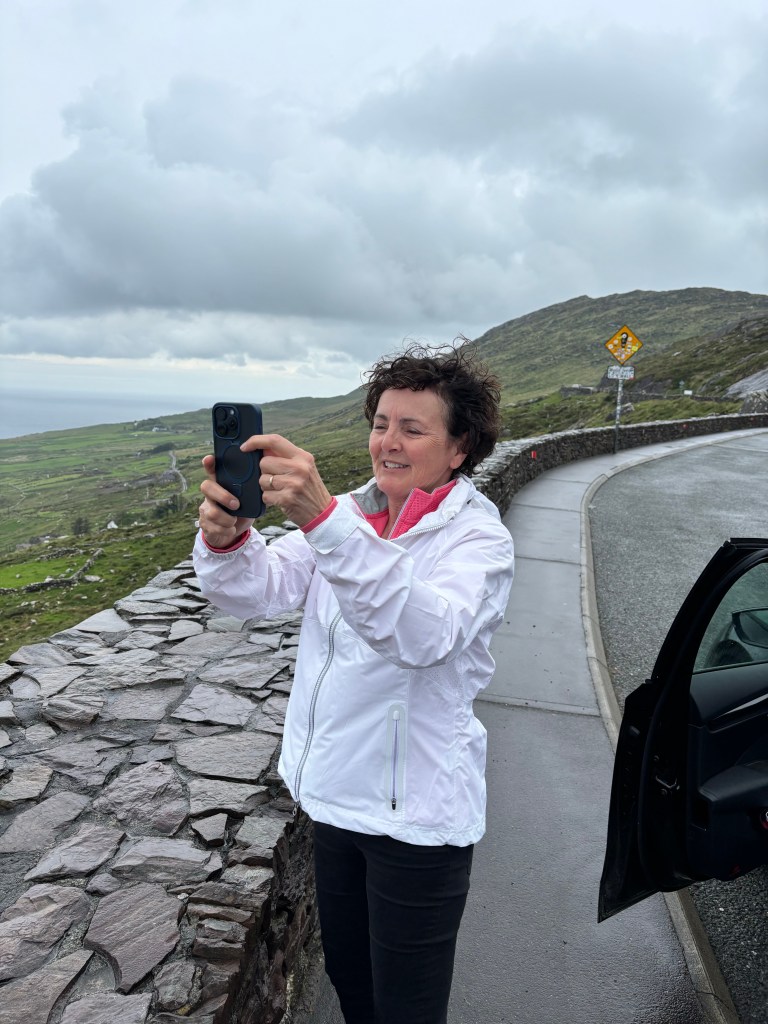
With the rain, wind and clouds our photo ops were limited at first so we did the next best thing.

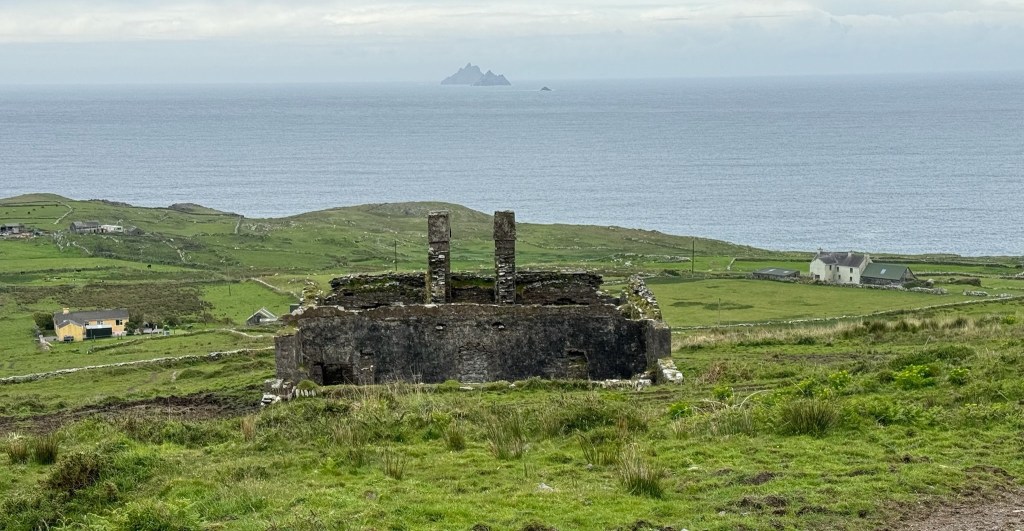
The land is rugged and rocky. Rock walls and abandoned stone buildings abound and one can only imagine the labour it took to create them.

Without the sunshine it’s a cold bleak landscape in places.

In the mist you can see Skellig Michael which was home to monastery beginning in the 6th century. Little Skellig appears beside it. The monks lived in bee hive style rock dwellings and somehow survived as an order on the island for more than 500 years.

Replica of a bee hive “house” on the mainland

Then it was on to the Sellig Ring which is the very western tip of the peninsula. No bus allowed! Still the one lane road meant pulling off into tiny spaces in the hedge or backing up to let a car come past. Peter was a pro.

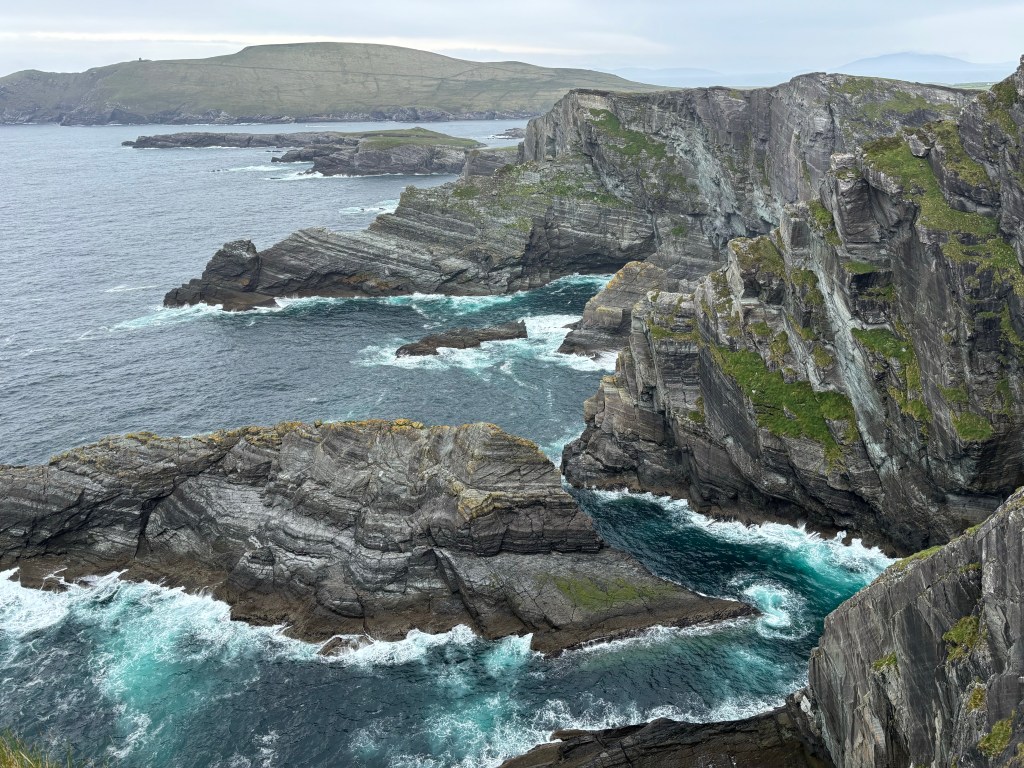
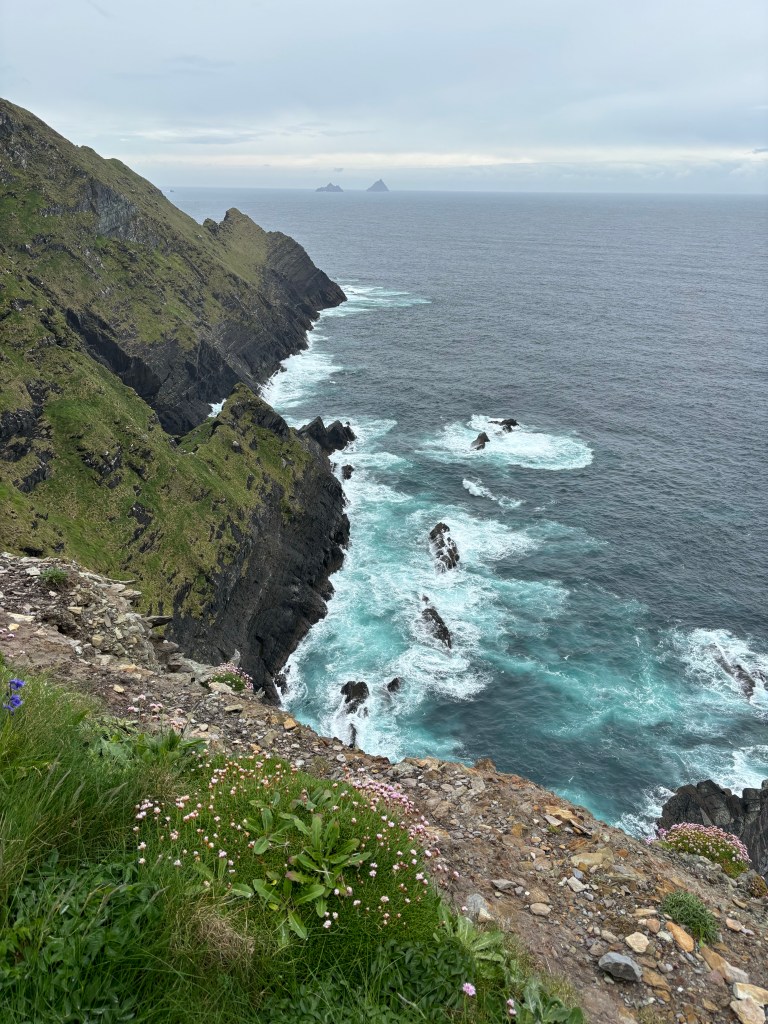
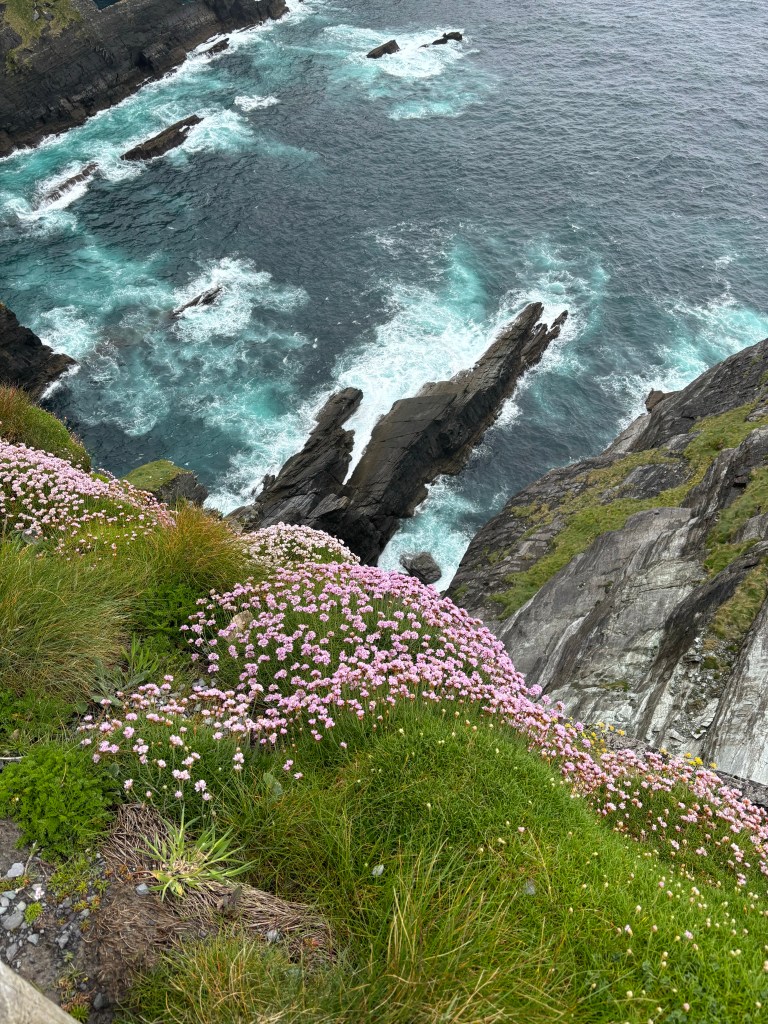
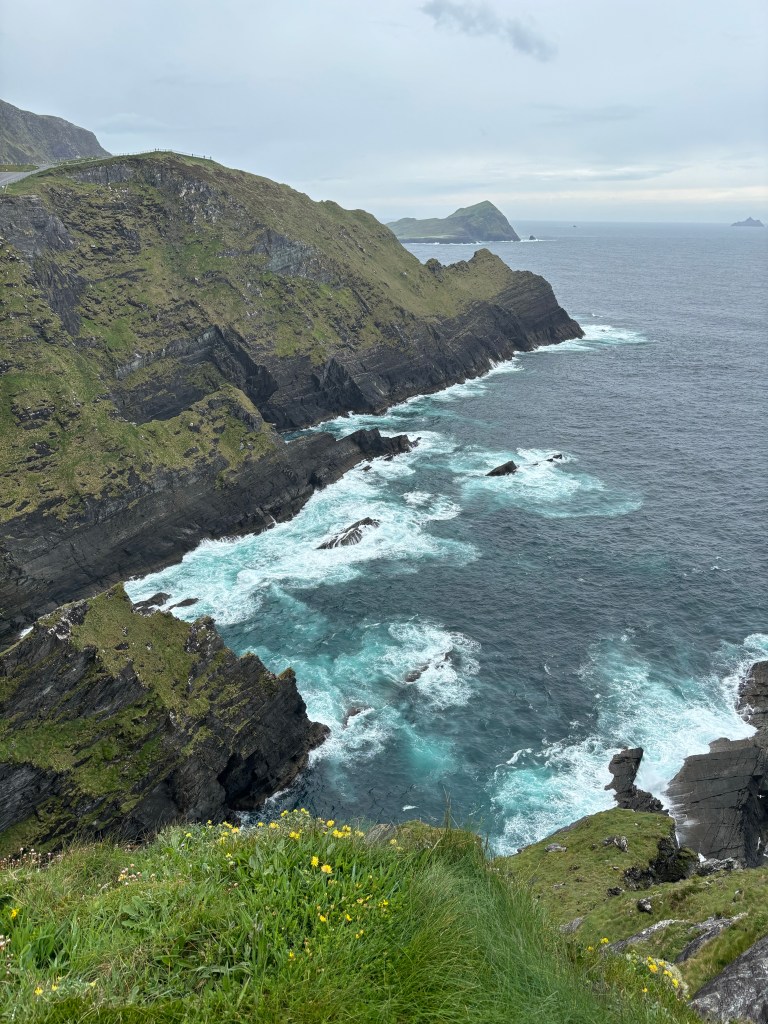
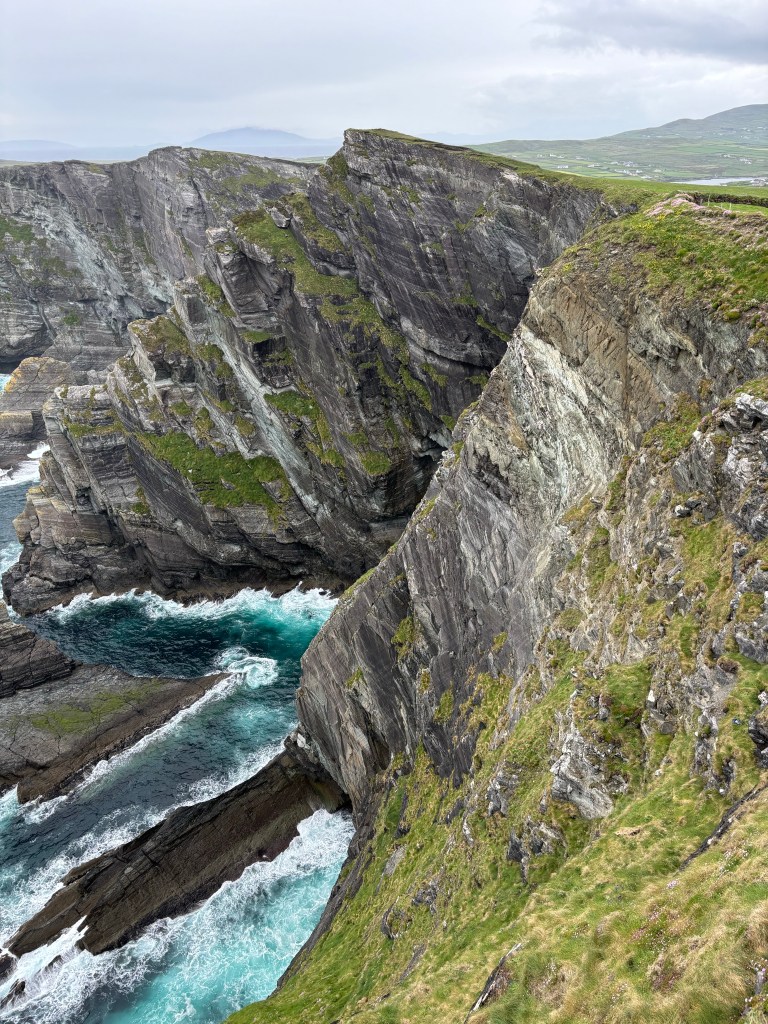
The Kerry Cliffs were spectacular. We climbed to the highest point to get the best views.

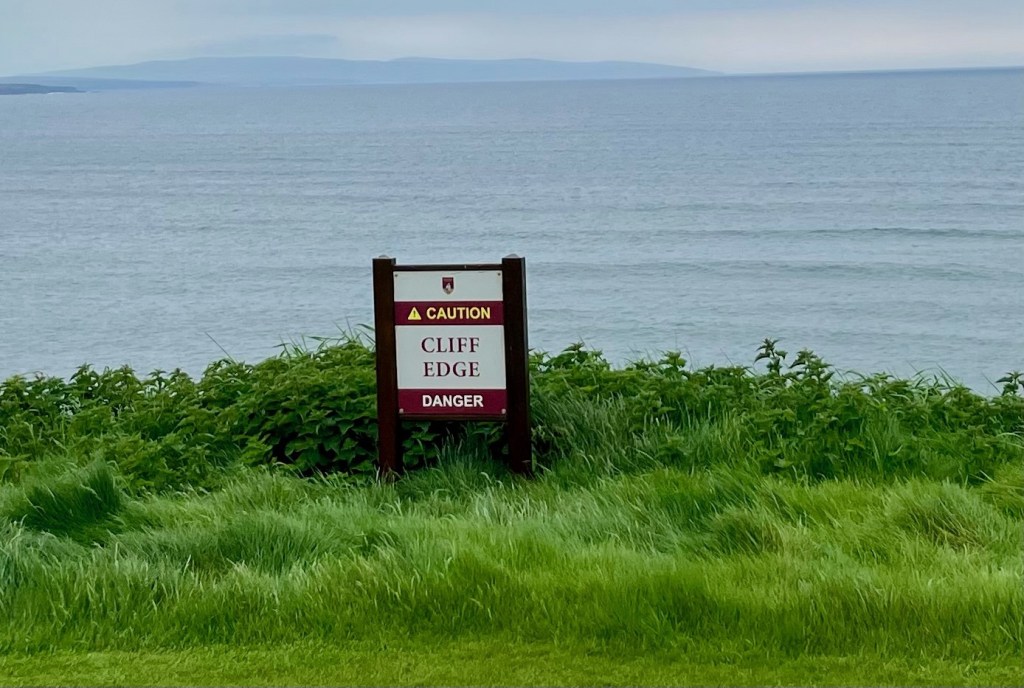
A bit close to the edge!

Back in the car for the harrowing journey (nearly exchanged outside mirrors with one oncoming car) through Portmagee and onto the “big” ring and home to Killarney.

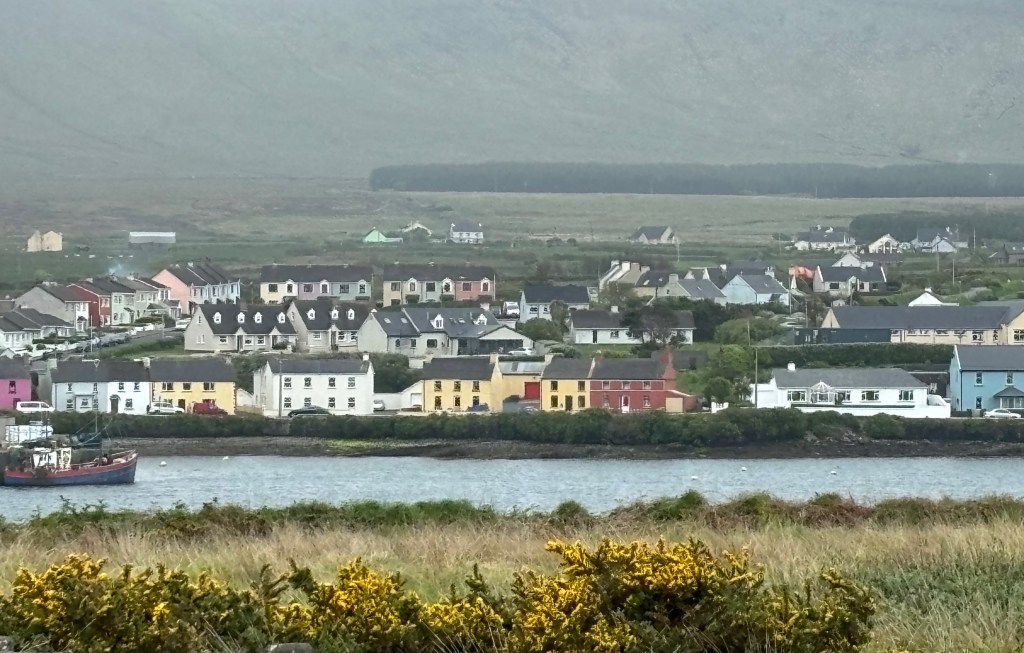
Portmagee, County Kerry

Dinner in an Irish pub and a whiskey tasting thereafter. Mind boggling choices from 1,600 different bottles.

Touring the Dingle Peninsula tomorrow including a big dinner celebration for Peter’s birthday.

Tralee

Our smiling Irish weather eyes came to a crashing end overnight as rain and wind lashed our new digs in Killarney where we had arrived after a 2 1/2 hour drive from Lahinch. Ominous forecasts in the morning had us very concerned golf at Tralee would be a non starter. But……our luck of the Irish came through and we faced nary a drop despite the presence of storms all around us.

The original nine hole Tralee GC came into existence in 1896 and 84 years later its members purchased the current site in Barrow, 14 Kms west of the town of Tralee. Arnold Palmer was hired to design a layout that opened in 1984 with the goal of attracting world wide attention. Mission accomplished in spades.

Tralee is also a course of two distinct nines. The front nine incorporates a limited amount of vertical dunes and as such is more windswept and open. And I do mean windswept. We were buffeted by cross winds upward of 25 – 30 mph which meant aiming well left or right of targets with dubious outcomes.

The presence of stone walls added another hazardous element.

Oh and the fairways ended abruptly in either knee high rough or the ocean.

The back nine introduced big dunes which helped temper the wind but meant challenging elevation changes and unique shots.

The hills, chasms, long grasses et al offer such a difference to the style of golf we’ve become so accustomed to “back home”. Here a miss is truly a miss.

The storm that threatened to arrive fortunately held off until we were done but created a unique image of clouds shrouding the clubhouse.

Unlike say, Lahinch which is at the village’s edge, Tralee is very secluded and has a completely different vibe. It was a workout in the wind and the ups and downs. Interestingly the last few kilometers to the club is via a narrow single lane road that the large touring coaches bringing groups of golfers traverse. Not sure how they do it.

Tomorrow is a Pit Day where we plan to explore the Ring of Kerry. If the volume of tourists in Killarney is any indication it will be a busy traffic day. According to the guide book all the coaches travel counterclockwise. We will not!

Lahinch

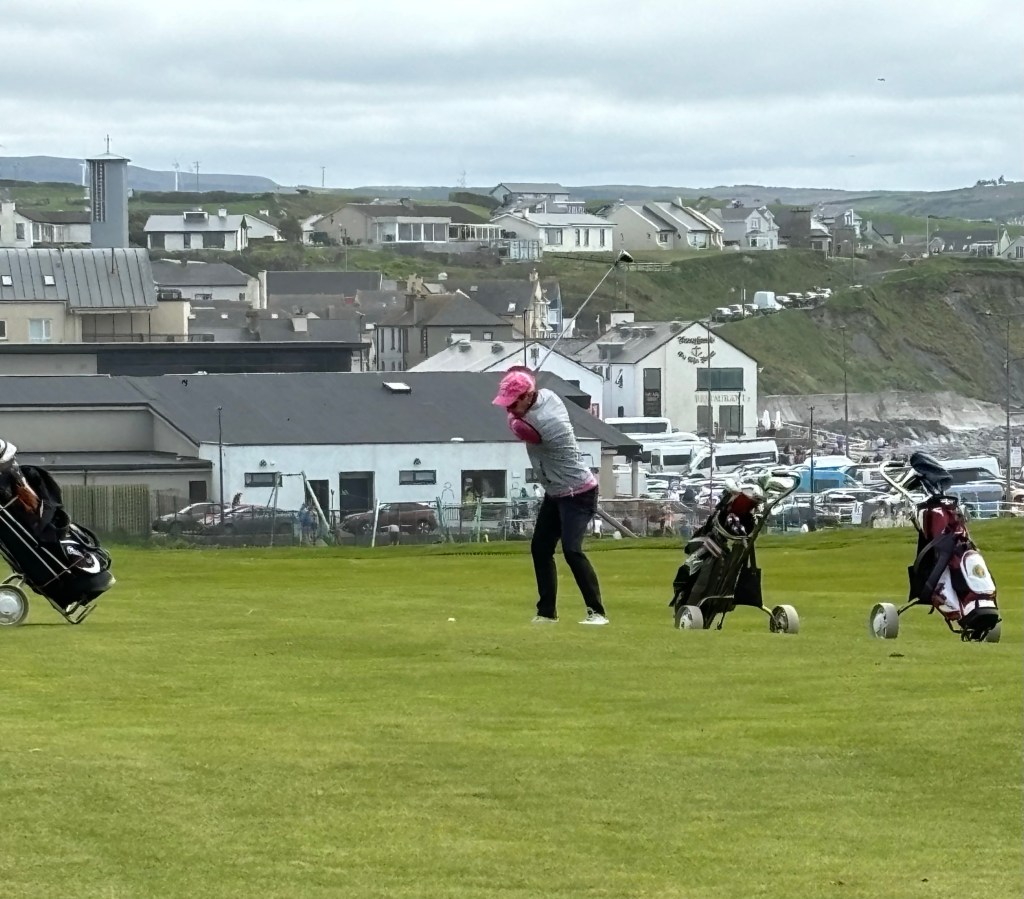
Created in 1892 on land that was discovered accidentally – they were looking elsewhere for a new “golfing ground” and stumbled across these dunes – Old Tom Morris redesigned the course in 1894. In 1927, Alistair MacKenzie of Augusta National fame (and other great layouts), redid much of the course. And finally, starting in 1999, Martin Hawtree was brought in to restore the MacKenzie traditions that had been undone over decades by zealous member committees. The result is an absolute gem that includes two of Morris’ original holes that have fortunately survived the test of time.

The inclusion of the goat in the logo reflects their presence on the property, a tradition, albeit reduced to only a few, that continues (we didn’t see any).

Our extremely good fortune of enjoying warmish, sunny, minimal wind weather continued. Even our caddies commented how lucky we were.

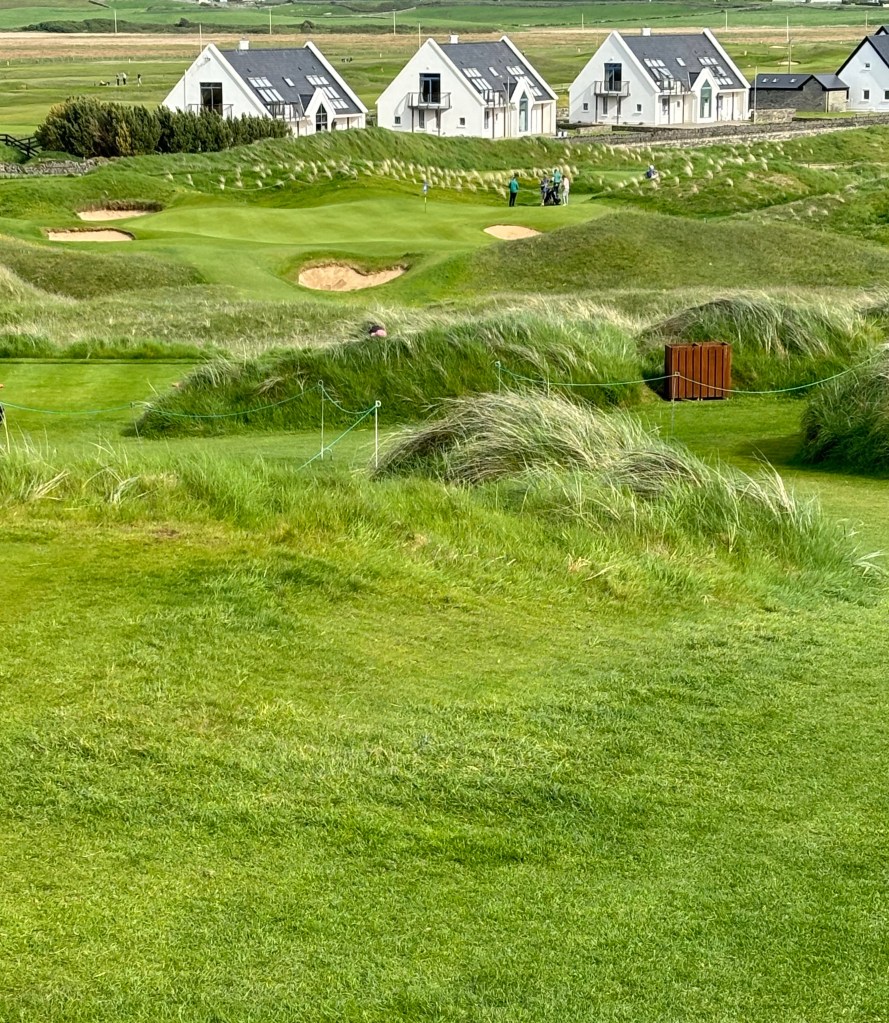
Lahinch captures all the elements of a links course. Seriously large sand dunes, humpty, bumpy fairways, cavernous bunkers that maddeningly collect shots, firm fescue where the ball rolls and rolls, drop offs around the greens that turn short misses into long chip shots and so on. Best of all it had great, consistent turf throughout.

Unlike other courses we’ve played, Lahinch had a different feel of being surrounded by the town, the ocean and stone wall boundary fence.

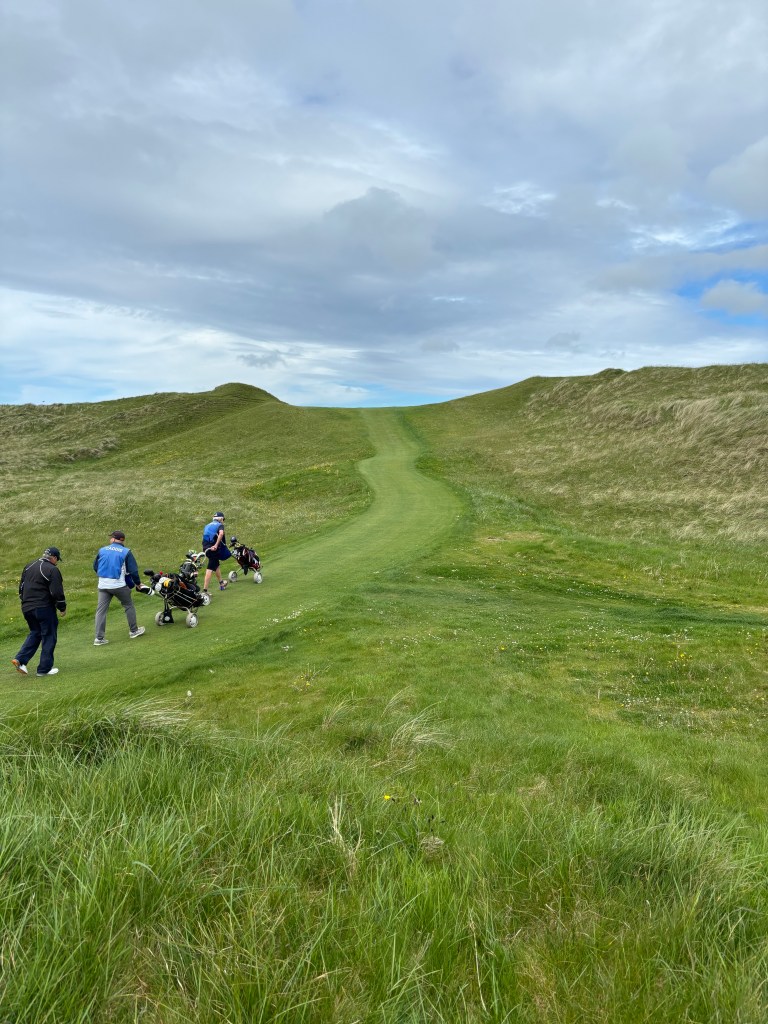
Yet again we experienced elevation changes that meant blind tee shots and even a blind par three.

The famous Klondyke hole, a Tom Morris original, requires an approach shot over a hill in the middle of the fairway.

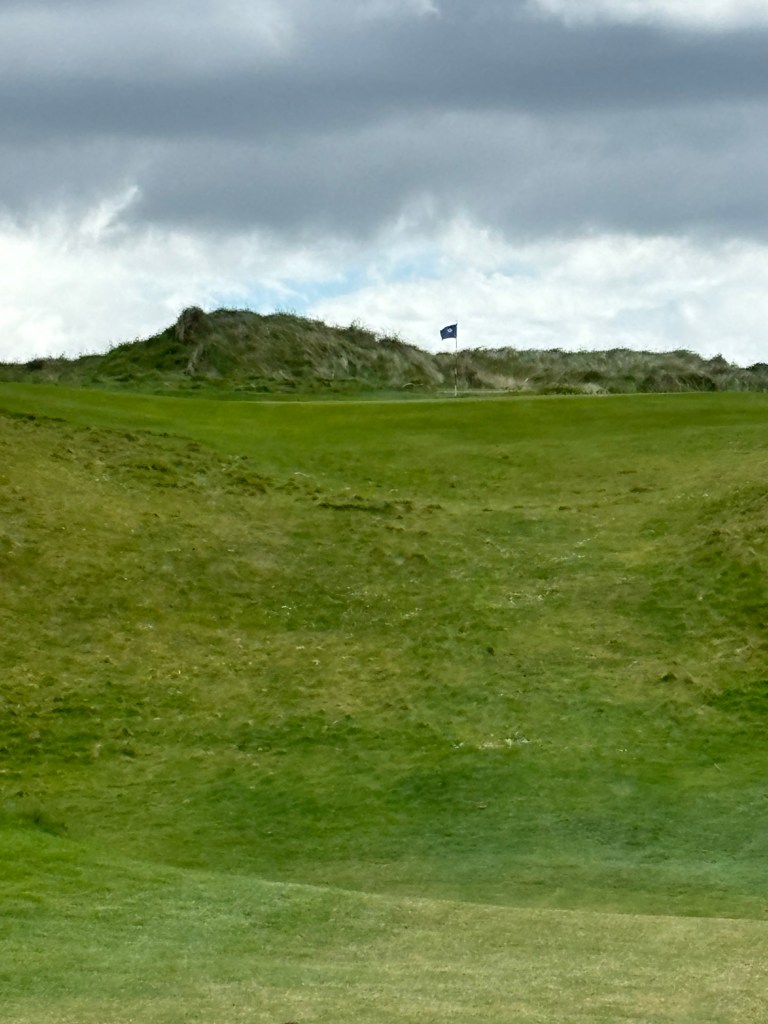
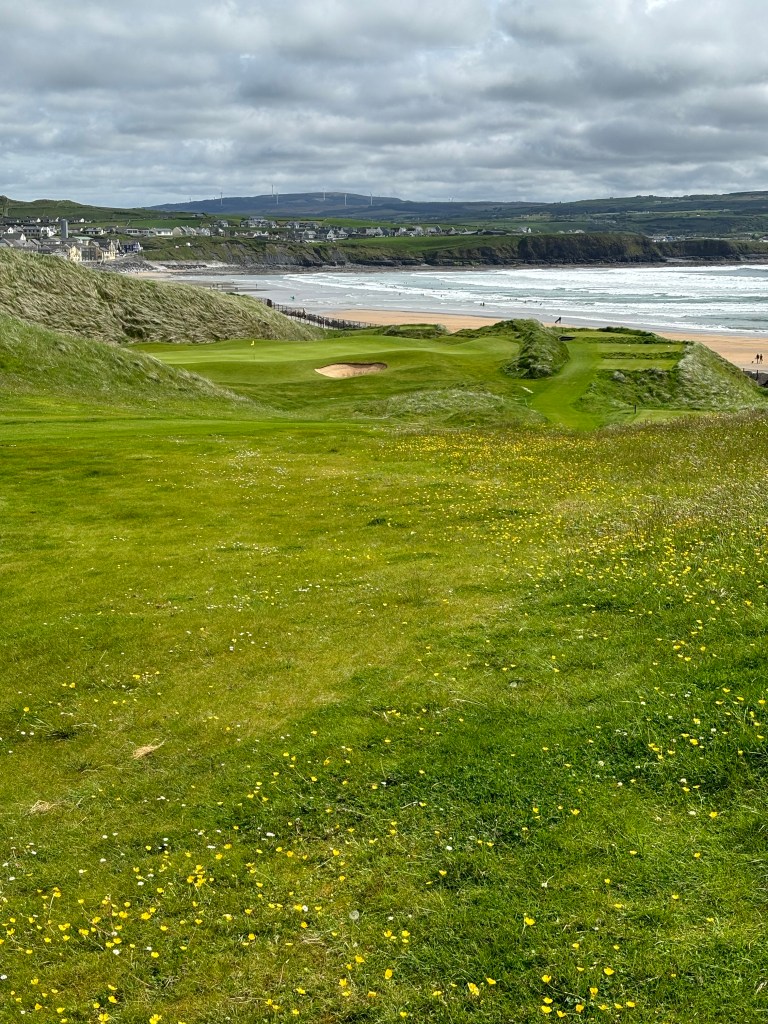
Only the front right corner of this par 3 green can be seen with the rest tucked behind those hills.

We agreed Lahinch was a course we would want to play again, sooner than not. Unfortunately/fortunately that’s not to be on this trip as we’re heading further south in to County Kerry and our home for the next week in Killarney.