Day 7 – Sunday. After sailing through the first week of our trip Mark was slammed by a bug (I thought Montazuma was Mexican, not Peruvian). A variety of different drugs seemed to mitigate the damage so with a full day of sights ahead of us it was onto the bus and off to Pisac, one of the many Inca ruins nearby. Trouble was the Peruvian roads are pockmarked with countless potholes meaning the bus driver slalomed down narrow mountain roads notwithstanding oncoming traffic. A further challenge is in the seeming absence of any police so they use speed bumps every few hundred yards to slow down traffic. And these are serious bumps. Stop, bump, go, slalom, repeat.
A quick history lesson: despite their relatively small number the Inca tribe, following a battle with the neighboring Chancas in 1438 was able to conquer all of what is now Peru, parts of Chile and Ecuador and a section of Bolivia under the dynamic leadership of their ruler, Pachacutec. In turn their rule came was challenged by the Spanish invasion commencing in 1532 and after forty years of major battles and running skirmishes the last of the Inca armies was defeated and their place consigned to history. They left behind many ruins, the most famous being Machu Pichu (although most books designate other locations as more important cities based where the emperor lived and/or did battle.
Pisac, at the head of the sacred valley, features all types of architecture – agriculture using dozens of terraces on the mountainside, military, residential and religious including a cemetery built into the cliffs.
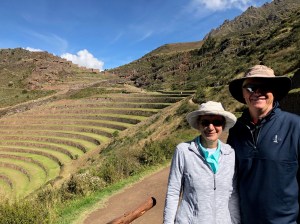
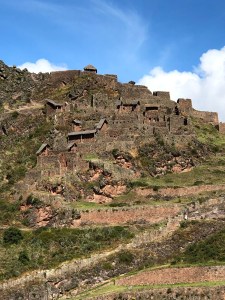
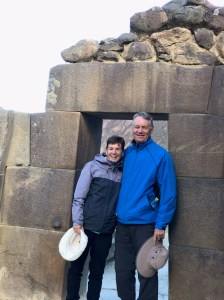
We wandered through the site and learned about ceremonies and some historical facts. Like the ancient Egyptians the Incas had the ability to move large stones great distances and construct walls with amazing precision.
Then it was off to the Potato Institute high in the hills. Another heart stopping ride as the narrow road had no guardrails and it was hundreds of feet straight down. We learned more about potatoes than imaginable including that the tuber originated in Peru and this farm had 1,360 different varieties (too bad Ireland only imported one variety). Today seeds are stored in Cusco and the world seed institute in Norway in case of disease. All the work is done by hand given the serious slope of the fields (and the remoteness of the farm). The head farmer demonstrated the seasonal work and techniques using a model It was an impressive display of ingenuity and perseverance.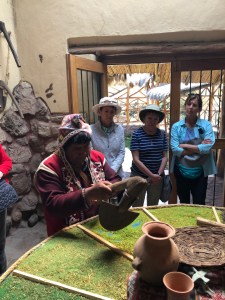 Back down to the river valley and along to Ollaytantambo which is a village of very bumpy cobbled streets too narrow for two way traffic. The main square gave the feel of a vibrant ski town given all the trekkers and street vendors surrounded by very large hills (we’re not quite in the Andes yet). This is the site of one of the more famous Inca – Spanish battles in 1537 where the former recorded a victory although it was a temporary setback for the invaders. Another Inca site was explored, explained and marvelled at give the construction skills and hoisting of massive rocks up mountains.
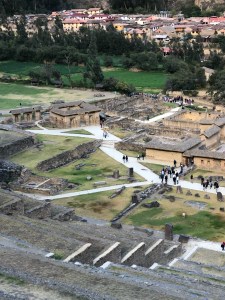
Back up the sacred valley to Urabamba for our last night in a real bed with a proper bathroom. Tomorrow the hike begins!

 The Bennetts On Tour